
Bernie Sanders Defends California Billionaire Tax as Voter Support Plummets Ahead of Election Day
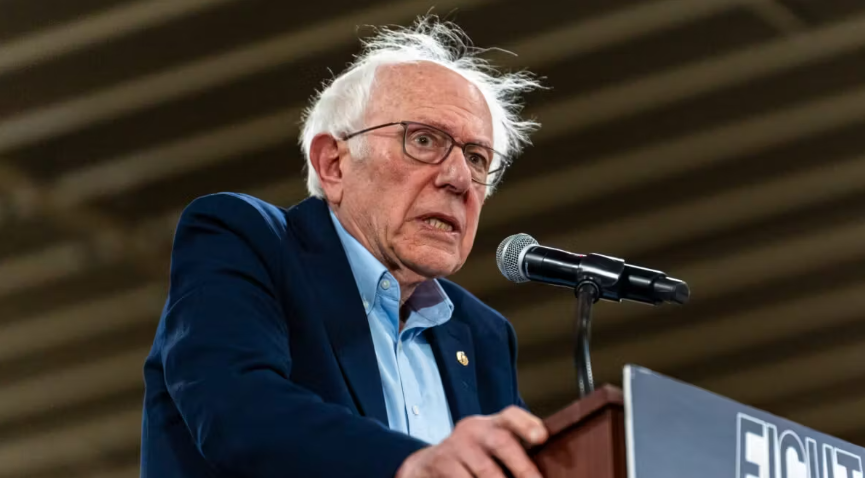
Sen. Bernie Sanders is defending California’s proposed billionaire tax despite new polling showing growing opposition to the controversial measure, which has divided prominent Democrats and triggered an expensive political battle ahead of Tuesday’s election.
The Vermont independent appeared on KCRA’s California Politics 360 program to promote Proposition 40, a ballot initiative that would impose a one-time 5% tax on the assets of billionaires who lived in California as of January 1, 2026, subject to certain exceptions.
Sanders argued that the measure is necessary to protect healthcare services and accused wealthy opponents of spending enormous sums to defeat it. His remarks came as two major statewide surveys showed more likely voters opposing the proposal than supporting it.
A University of California, Berkeley poll conducted for the Los Angeles Times found that 50% of likely voters opposed Proposition 40, compared with 42% who supported it. The results represented a significant reversal from September, when the measure held a narrow advantage.
A separate Public Policy Institute of California survey produced similar findings, with 52% of likely voters opposing the tax and 46% supporting it.
The declining numbers present a challenge for Sanders and the healthcare unions that have spent months promoting the proposal as a way to generate additional revenue for California’s healthcare system.
During his television interview, Sanders blamed the shift in public opinion on an aggressive advertising campaign financed by wealthy individuals who would potentially be affected by the tax.
He argued that billionaires were using their financial resources to influence voters while attempting to preserve their own fortunes.
Opponents had spent at least $161 million fighting Proposition 40 as of Friday, according to campaign spending figures cited by KCRA. Broader fundraising totals reported by the Los Angeles Times showed nearly $368 million contributed to opposition efforts, compared with approximately $36 million supporting the measure.
Sanders characterized the campaign against the proposal as an example of wealthy Americans exercising disproportionate influence over the political process.
He also criticized warnings that billionaires could leave California if the tax becomes law, arguing that the state’s healthcare needs should take priority over concerns about wealthy residents relocating.
The proposal has generated substantial controversy because it would tax accumulated wealth rather than annual income.
Unlike California’s existing income tax system, Proposition 40 would calculate liability based on the value of qualifying assets held by individuals meeting the measure’s billionaire threshold.
That distinction has raised questions about how the state would value privately held companies, business ownership interests and other assets that are not easily converted into cash.
Opponents argue that taxing assets could force business owners to sell investments or ownership stakes to meet their obligations. They also warn that the measure could encourage wealthy residents and entrepreneurs to establish themselves outside California.
Supporters maintain that the one-time levy would raise money for healthcare programs and help offset reductions in federal healthcare funding.
The initiative was developed by the Service Employees International Union-United Healthcare Workers West, which has promoted the tax as a response to financial pressures affecting hospitals and healthcare providers.
The proposal has exposed divisions within California’s Democratic Party.
Gov. Gavin Newsom opposes Proposition 40, warning that the state could lose wealthy taxpayers and the substantial income tax revenue they already provide.
Newsom has argued that a wealth tax would be better addressed at the federal level rather than imposed by an individual state.
His position places him at odds with Sanders, Rep. Ro Khanna and other progressive Democrats who have publicly endorsed the measure.
The California Democratic Party’s executive board narrowly voted to support Proposition 40 in August, securing the endorsement with 61.7% of the vote, just above the required 60% threshold.
That endorsement did not resolve the disagreement among the state’s leading Democratic officials.
Democratic gubernatorial candidate Xavier Becerra has also opposed the proposal while discussing the possibility of pursuing a different tax increase on high-income residents.
Sanders dismissed that alternative during his interview, maintaining that broader action is necessary to address wealth inequality.
The senator also used the appearance to promote his proposal for a national wealth tax on billionaires.
Sanders has advocated an annual 5% federal tax on billionaire wealth, arguing that the revenue could finance healthcare, childcare, affordable housing and public education programs.
The federal proposal differs from California’s Proposition 40, which would impose a one-time tax rather than an annual levy.
The California measure has become one of the state’s most expensive ballot initiative battles, with wealthy technology investors and business leaders contributing heavily to opposition campaigns.
Two additional ballot measures, Propositions 41 and 42, could also affect the outcome.
Proposition 41 would establish additional requirements involving state taxation and spending, while Proposition 42 would restrict certain taxes on personal assets, savings and retirement holdings.
Both measures contain provisions that could prevent Proposition 40 from taking effect if voters approve the competing initiatives under the applicable election rules.
Recent polling indicates that those proposals are also facing voter resistance, adding uncertainty to the broader debate over California’s tax policies.
The latest surveys suggest that opposition to Proposition 40 extends beyond Republican voters.
Although Democrats remain more supportive of the measure, a substantial minority oppose it. Older voters have also expressed greater resistance, while younger Californians are more likely to favor the proposed tax.
The Berkeley survey found that approximately six in ten voters age 65 and older opposed Proposition 40, compared with strong support among voters younger than 30.
The findings illustrate the challenge facing the campaign as it attempts to persuade undecided voters during the final days before Election Day.
Sanders remains committed to the proposal and continues to argue that billionaires should contribute more toward public services.
Opponents, including Newsom and several major business figures, maintain that the measure could damage California’s economic competitiveness and undermine the tax revenue needed to finance existing programs.
With the November 3 election approaching, the latest polling shows Proposition 40 trailing after months of advertising, fundraising and political campaigning.
California voters will now decide whether to authorize the proposed wealth tax or reject an initiative that has divided Democratic leaders and generated a statewide debate over taxation, healthcare funding and the economic consequences of targeting billionaire assets.