
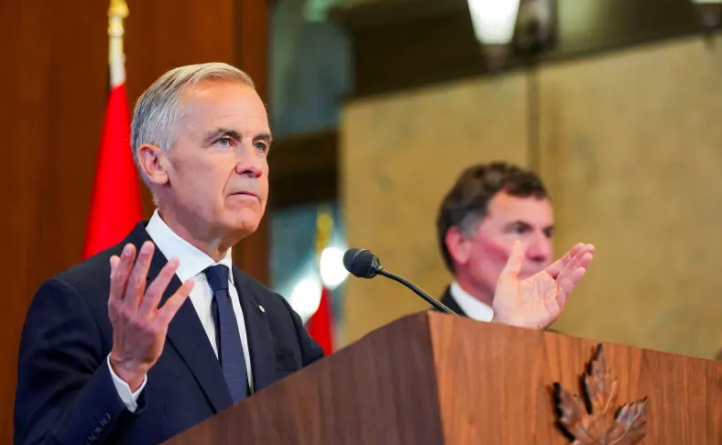
Canadian PM Mark Carney Declares Canada ‘At War’ With Trump Over Trade: ‘We Got Attacked’
Canadian Prime Minister Mark Carney dramatically escalated his rhetoric against President Donald Trump over the growing U.S.-Canada trade dispute, declaring that his country is effectively “at war” after Washington imposed sweeping new tariffs on Canadian goods.
Carney made the remarks Saturday after negotiations between the two longtime allies collapsed at the last minute. The Trump administration subsequently allowed new 50% tariffs to take effect on billions of dollars worth of Canadian imports, including beer, cheese, electronics, cement and hockey equipment.
Asked whether his increasingly combative posture meant Canada was entering a trade war with the United States, Carney did not shy away from the characterization. “We were attacked. You’re at war when you get attacked. We got attacked,” he said, adding that Canada has the resources and strategy necessary to respond.
Carney accused the Trump administration of attempting to pressure Canada into accepting what he described as a “bad deal.” He said Washington introduced new demands during the final stages of negotiations that Canada considered economically unacceptable and potentially damaging to its sovereignty.
Among the disputed issues were proposed restrictions on Canada’s future trade relationships with other countries and rules governing Canadian components in automobiles. Carney also claimed American negotiators made unacceptable demands involving protections for the French language and Quebec culture.
Carney insisted Canada would not sacrifice its independence simply to obtain tariff relief from Washington. He argued that Canadians have the right to determine their own trade relationships and domestic policies, framing the dispute as increasingly about national sovereignty rather than tariffs alone.
Trump responded Sunday by accusing Canada of wanting preferential treatment from the United States while maintaining trade barriers against American products. The president specifically criticized Canadian tariffs affecting American farmers and declared that the longstanding arrangement would no longer continue.
The Trump administration argues that Canada has enjoyed unusually favorable access to the enormous American consumer market for decades while maintaining policies that disadvantage U.S. exporters. U.S. Trade Representative Jamieson Greer has defended the new tariffs and blamed Ottawa for walking away from an agreement that Washington believed was favorable to Canada.
Carney is now preparing direct retaliation. Canada plans to impose matching tariffs on American products beginning Sept. 8, targeting sectors including steel, dairy, appliances, agricultural equipment and electronics. Carney has pledged that Ottawa will respond “dollar for dollar” to the American measures.
The confrontation could have significant economic consequences for both countries because their economies remain deeply interconnected. Canada sends roughly 70% of its exports to the United States, while businesses and consumers on both sides of the border rely on supply chains that have operated with relatively few barriers for decades.
The escalating dispute also creates uncertainty surrounding the future of the U.S.-Mexico-Canada Agreement. The trade pact negotiated during Trump’s first term governs an enormous amount of North American commerce, but relations between Washington and Ottawa have deteriorated sharply as the president pushes for major changes in America’s economic relationship with Canada.
Carney says Canada will respond by accelerating efforts to diversify its trading relationships and reduce its dependence on the American market. Trump, meanwhile, is showing no indication that he intends to retreat from his tariff strategy, leaving the two neighboring countries headed toward an increasingly aggressive economic confrontation.