
Federal Grand Jury Refuses to Indict Cassidy Hutchinson After Disputed Testimony About President Trump
A federal grand jury in Washington, D.C., declined Tuesday to indict former White House aide Cassidy Hutchinson, rejecting the Justice Department’s attempt to pursue criminal charges stemming from her controversial testimony about President Trump’s actions on January 6, 2021.
The decision follows an investigation into whether Hutchinson provided false information to Congress when she testified before the House committee investigating the Capitol riot in June 2022.
According to people familiar with the proceedings, federal prosecutors presented evidence seeking an indictment, but grand jurors declined to approve the proposed charges.
The rejection represents a setback for the Justice Department, although it does not establish whether Hutchinson’s testimony was truthful or inaccurate.
Hutchinson, who served as a special assistant to White House Chief of Staff Mark Meadows during Trump’s first administration, became a prominent witness in the congressional investigation after delivering testimony that attracted national attention.
Her most widely discussed allegation involved an account of President Trump supposedly attempting to grab the steering wheel of his presidential vehicle after Secret Service personnel refused to transport him to the Capitol.
Hutchinson acknowledged during her testimony that she had not personally witnessed the alleged confrontation. Instead, she said she learned about it from then-White House Deputy Chief of Staff Tony Ornato.
President Trump strongly denied the allegation, describing Hutchinson as a “total phony” and disputing her account of his behavior.
The controversy intensified in March 2024 when House Republicans released previously undisclosed testimony from the Secret Service agent who drove the presidential vehicle that day.
The driver directly contradicted the allegation that Trump attempted to seize the steering wheel or physically lunge toward the front of the vehicle.
His testimony nevertheless confirmed that Trump had wanted to travel to the Capitol after addressing supporters near the White House.
Those conflicting accounts became central to Republican criticism of Hutchinson and the congressional committee that relied on her testimony.
Republican lawmakers subsequently accused Hutchinson of providing misleading information under oath and referred the matter to federal authorities for potential prosecution.
Hutchinson has maintained that she testified truthfully about what she knew and what others had told her.
The latest investigation was handled by the Justice Department’s Civil Rights Division, according to reporting from CBS News.
During an unrelated federal court hearing Tuesday, Justice Department attorney Neville Hedley informed U.S. Magistrate Judge Zia Faruqui that a grand jury had declined to approve a proposed indictment.
Hedley did not publicly identify the individual involved, but multiple people familiar with the proceedings confirmed that the rejected indictment concerned Hutchinson.
The precise allegations and evidence presented to grand jurors have not been publicly disclosed in full.
ABC News reported that prosecutors had sought charges involving allegedly false statements to Congress.
The Justice Department had not issued a detailed public explanation of the grand jury’s decision as of Tuesday evening.
Grand juries determine whether prosecutors have established probable cause to bring criminal charges. They do not decide whether a defendant is guilty.
An indictment ordinarily requires agreement from at least 12 members of a federal grand jury, which can consist of between 16 and 23 people.
When a grand jury declines to indict, prosecutors cannot proceed on the rejected indictment, although they may sometimes pursue additional evidence or present a revised case.
The decision therefore leaves Hutchinson without criminal charges arising from this particular presentation of evidence.
The case has renewed attention on the congressional investigation into January 6 and the disputed accounts presented during its public hearings.
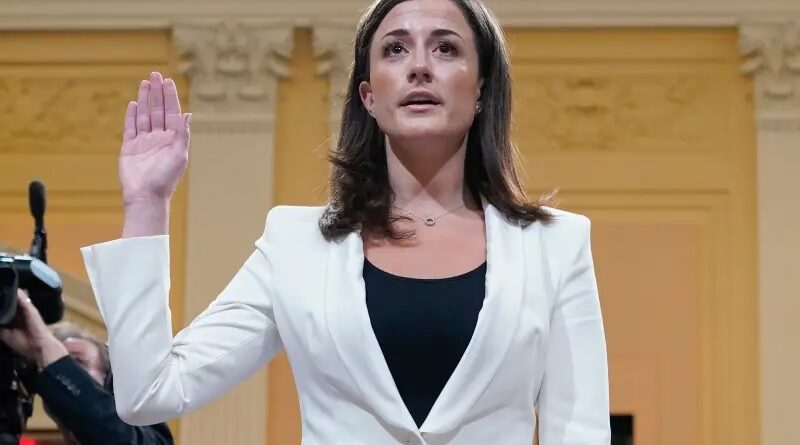
Hutchinson testified at a nationally televised hearing arranged with approximately one day’s notice, describing conversations and events she said occurred inside the White House before and during the Capitol riot.
In addition to the presidential vehicle allegation, she testified that Trump wanted security screening equipment removed near his rally because some attendees carrying weapons were not there to harm him.
She also described conversations involving Meadows and other senior officials as the situation at the Capitol deteriorated.
Her testimony became an important part of the committee’s public presentation of events surrounding the certification of the 2020 presidential election.
However, the secondhand nature of her account about the presidential vehicle drew particular scrutiny.
House Republicans later argued that the committee had placed substantial emphasis on an allegation contradicted by testimony from a person who was actually present.
The Secret Service driver’s account established a significant factual disagreement about the alleged physical confrontation, although it did not contradict every aspect of Hutchinson’s testimony.
Hutchinson has consistently maintained that she accurately conveyed what she was told.
She has also alleged that individuals associated with Trump’s political circle attempted to influence her cooperation with congressional investigators.
According to her testimony, she was offered potential employment opportunities and financial assistance while participating in the investigation.
She further alleged that an attorney representing her at the time encouraged her to limit what she disclosed to the committee.
Those claims became part of the broader congressional inquiry and were separate from the question of whether her testimony about the presidential vehicle was knowingly false.
Proving a criminal false-statement offense requires more than demonstrating that a witness repeated an account later contradicted by another person.
Prosecutors generally must establish that a materially false statement was made knowingly and willfully.
That distinction is especially important when testimony involves information a witness says was received from someone else.
Even if the underlying account proves inaccurate, criminal liability can depend on what the witness actually knew and intended when testifying.
The grand jury’s refusal to indict does not provide a public explanation of which evidentiary or legal issues influenced its decision.
Hutchinson’s testimony remains part of the historical record of the congressional investigation.
President Trump was impeached by the House in January 2021 on a charge of incitement of insurrection following the Capitol riot, but the Senate subsequently acquitted him.
A separate federal criminal case brought by special counsel Jack Smith concerning Trump’s efforts to challenge the 2020 election was abandoned after his victory in the 2024 presidential election.
The Justice Department cited its longstanding policy against prosecuting a sitting president when ending that case.
Trump has continued disputing the conclusions reached by the January 6 committee and has criticized several witnesses and investigators associated with its work.
The administration’s investigation of Hutchinson developed against that backdrop, with Republican lawmakers seeking accountability for testimony they believed was misleading.
Hutchinson, meanwhile, has continued defending her account and rejecting allegations that she deliberately deceived Congress.
The grand jury decision is also notable because prosecutors ordinarily obtain indictments when they present evidence sufficient to establish probable cause.
A refusal is relatively uncommon, particularly in high-profile federal investigations.
Nevertheless, grand jurors retain independent authority to reject proposed charges when they are not persuaded that the legal standard has been satisfied.
For now, Hutchinson will not face prosecution based on the indictment rejected Tuesday.
The Justice Department has not announced whether it intends to pursue additional investigative steps or make another attempt to secure charges.
The outcome leaves unresolved the longstanding disagreement over Hutchinson’s testimony, particularly her secondhand account of the alleged confrontation inside the presidential vehicle.
While the former White House aide has maintained that she told Congress the truth, President Trump and Republican lawmakers have continued challenging the reliability of her statements.
Tuesday’s decision settles the immediate question of whether the grand jury would authorize the proposed prosecution, but it does not resolve every factual dispute surrounding her testimony.