
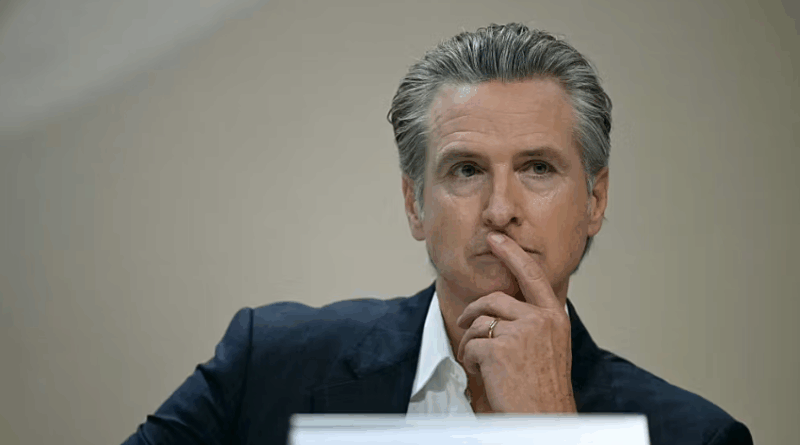
Gavin Newsom Solicited $340M In ‘Behested Payments’ From Special Interests, Filings Reveal
California Gov. Gavin Newsom is facing renewed scrutiny over his fundraising practices after state records revealed he has solicited more than $340 million in behested payments from wealthy donors and special interests, some of whom later received favorable treatment or lucrative state contracts.
The revelations come as Newsom has gone on the offensive over multiple federal investigations involving himself, his wife and associates, accusing President Trump and federal authorities of engaging in political lawfare. Critics, however, have pointed to the governor’s own financial dealings as raising significant ethical questions.
According to state disclosure records, Newsom has reported 1,325 behested payments totaling $347,240,506 since 2011, when he served as California’s lieutenant governor. Under California law, behested payments are legal and must be used for charitable, governmental or legislative purposes. Donations are required to be disclosed once they exceed $5,000 from a single source during a calendar year.
By comparison, former Gov. Jerry Brown reported just $35.5 million in behested payments between 2010 and 2018, highlighting the unprecedented scale of Newsom’s fundraising efforts.
The governor’s use of the fundraising mechanism exploded during the COVID-19 pandemic. In 2020 alone, Newsom reported $226.5 million in behested payments, accounting for nearly two-thirds of all the money he has raised through the practice since 2011.
Some of the donations have attracted particular scrutiny because of subsequent state actions.
Blue Shield donated $20 million in September 2020. Months later, Newsom awarded the insurer a $15 million no-bid contract to assist with distributing COVID-19 vaccines across California.
Kaiser Foundation contributed $9.75 million to the COVID-19 Response Fund in December 2020. By 2022, Newsom approved another no-bid contract allowing Kaiser to help administer the state’s Medi-Cal program.
Since 2020, Newsom has reported more than $330 million in behested payments directed toward climate programs, workforce initiatives, immigrant services, wildfire recovery, official state travel and the California Partners Project, a nonprofit co-founded by his wife, Jennifer Siebel Newsom.
Records indicate that approximately $4.8 million has flowed to the California Partners Project since 2020.
Among its largest contributors is the Federated Indians of Graton Rancheria, which has donated roughly $2.3 million to the organization. In 2023, Newsom appointed the tribe’s chairman, Greg Sarris, to the University of California Board of Regents.
The tribe also donated $500,000 in April 2024, months before Newsom’s administration urged federal officials to reject a competing casino proposal from the Koi Nation. Another $500,000 donation followed in April 2025, shortly before California sued to block the rival project.
Silicon Valley Bank also made four separate $25,000 donations to the California Partners Project in 2021. Two years later, Newsom publicly lobbied the Biden administration as federal officials attempted to prevent the bank’s collapse. Reports later revealed that three of Newsom’s private wineries maintained business relationships with Silicon Valley Bank.
The governor’s fundraising activities remain under intense scrutiny. Earlier this year, Newsom agreed to pay a $31,500 ethics fine after regulators determined he had failed to timely disclose millions of dollars in behested payments related to wildfire relief efforts.
Political communications expert Dan Schnur previously described Newsom’s use of behested payments benefiting his wife’s nonprofit as an “obvious loophole” in campaign finance laws.
“They are not breaking any laws,” Schnur said, “but [Newsom] is following this law more aggressively than any other politician in modern memory.”
Despite the criticism, Newsom has denied any wrongdoing. A spokesperson for the governor previously insisted that his decisions are made solely in the best interests of Californians and that charitable contributions play no role in his decision-making.
“Charitable contributions play no role in his decision-making,” the spokesperson said. “Any claim to the contrary is categorically false.”