
Hakeem Jeffries Vows Democrats Will Refuse to Work With Stephen Miller as Trump Prepares for New Congressional Showdown
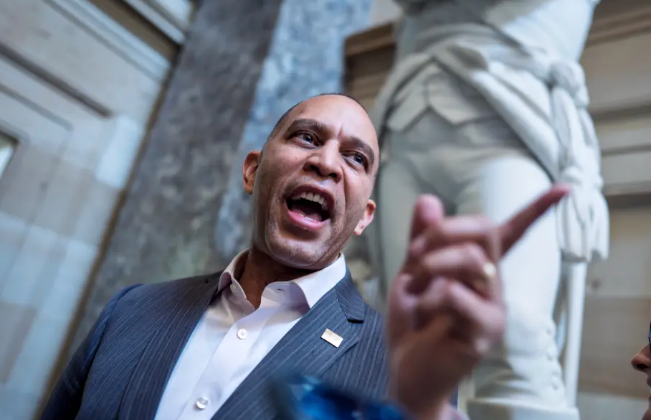
House Democratic Leader Hakeem Jeffries declared Sunday that Democrats will refuse to work with President Trump’s incoming White House chief of staff, Stephen Miller, signaling a major confrontation between the administration and the incoming Democratic-controlled Congress. Jeffries condemned the president’s decision to promote his longtime adviser and made clear that cooperation with Miller is off the table before he even assumes his new position.
Appearing on ABC’s “This Week” with Jonathan Karl, Jeffries delivered a series of attacks against Miller, accusing him of overseeing the administration’s aggressive immigration enforcement policies. The New York Democrat described the appointment as irresponsible and argued that Miller represents the political direction voters rejected during Tuesday’s midterm elections.
Jeffries said Miller was responsible for shaping the administration’s mass deportation strategy, which has remained one of President Trump’s central priorities throughout his second term. He accused the White House adviser of promoting policies that have harmed immigrant communities and contributed to deadly confrontations involving federal immigration enforcement.
The Democratic leader specifically invoked the deaths of Alex Pretti and Renee Nicole Good, blaming the administration’s immigration policies for the incidents. His remarks reflected the continuing political dispute over federal immigration operations and the government’s handling of confrontations involving enforcement officers.
Jeffries then made his position on future cooperation unmistakable, declaring that there would be no opportunity to work with Miller or the policies he represents. The statement effectively ruled out a normal working relationship between the incoming House Democratic leadership and one of the president’s most influential advisers.
Karl pressed Jeffries on whether he was abandoning the communication channels that previously existed between congressional Democrats and former White House chief of staff Susie Wiles. Jeffries acknowledged the distinction but insisted that Miller’s appointment made a similar relationship unacceptable.
The refusal represents a significant development as Washington prepares for divided government. White House chiefs of staff traditionally serve as important intermediaries between the president and congressional leaders, helping coordinate negotiations over federal spending, legislation, and other government priorities.
By ruling out cooperation with Miller, Jeffries is establishing a confrontational position before Democrats formally take control of the House in January. The decision could complicate negotiations on major legislative issues and increase the likelihood of prolonged disputes between Congress and the White House.
President Trump announced Friday that Miller would replace Wiles as chief of staff beginning Monday, November 9. The appointment followed Republicans’ sweeping losses in the midterm elections, which handed Democrats control of both chambers of Congress and dramatically altered the political environment facing the administration.
Trump praised Miller as one of his most trusted advisers and expressed confidence in his ability to manage White House operations. The president also thanked Wiles for her service, announcing that she would transition to a position within his political operation.
Miller has been a central figure in Trump’s political movement for years, helping develop immigration policies during the president’s first administration and returning to a senior White House position following the 2024 election. His influence has extended across border security, deportation operations, and the administration’s broader domestic policy agenda.
His promotion indicates that President Trump intends to maintain his commitment to strict immigration enforcement despite the Republican Party’s electoral setbacks. Rather than selecting an adviser associated with a more conciliatory approach, Trump has elevated one of the administration’s most outspoken advocates for its existing policies.
Jeffries had already condemned the appointment Friday, describing Miller as a dangerous extremist and demanding his removal from government. His Sunday television appearance reinforced that position and demonstrated that Democratic leaders are preparing to make Miller a major focus of their opposition to the administration.
The Democratic leader also emphasized that his party’s election victories would provide what he called a firewall against the White House. With Democrats preparing to control both the House and Senate, congressional leaders will have greater authority to block legislation, conduct oversight investigations, and challenge administration decisions.
Jeffries’ comments extended beyond Miller to War Secretary Pete Hegseth, who is facing renewed impeachment threats over his handling of the conflict with Iran. Asked whether he would support a resolution from Republican Rep. Thomas Massie seeking Hegseth’s removal, Jeffries confirmed that he would vote in favor.
The Democratic leader accused Hegseth of abusing his authority and undermining national security. He also blamed the administration’s military campaign against Iran for increasing energy prices and placing additional financial pressure on American households.
Jeffries said House Democrats would discuss the proposed impeachment resolution when lawmakers return to Washington on Tuesday. Although he expressed confidence that the measure would receive substantial Democratic backing, he stopped short of guaranteeing unanimous support from his party.
The interview also addressed the investigations Democrats intend to pursue once they assume control of Congress. Incoming House Oversight Committee Chairman Robert Garcia has already warned administration officials to prepare for congressional scrutiny, including potential investigations involving Miller.
Jeffries declined to specify whether Miller would be compelled to testify before congressional committees. Instead, he said those decisions would be left to lawmakers overseeing the House Judiciary and Oversight committees, including Reps. Jamie Raskin and Garcia.
The comments suggest that congressional investigations could become a central feature of the next two years. Democrats have identified immigration enforcement, military operations, executive authority, and alleged misconduct by administration officials as potential areas of scrutiny.
President Trump, meanwhile, has indicated that he is willing to negotiate with Democratic leaders on certain issues while maintaining his authority to reject legislation he opposes. The president has also warned that he will not abandon his administration’s priorities simply because Republicans lost their congressional majorities.
The disagreement over Miller illustrates the challenges ahead. While Trump has selected a longtime loyalist to help manage the White House during a difficult political period, Jeffries has publicly rejected the possibility of working with that adviser.
The confrontation also raises questions about how Democrats intend to balance their promised investigations with the legislative responsibilities that accompany control of Congress. Federal spending, government funding deadlines, and other national priorities will still require negotiations between lawmakers and the administration.
For now, Jeffries appears determined to establish a firm line against Miller and the immigration policies he helped develop. His refusal to cooperate comes before the new chief of staff has officially begun his duties, setting an adversarial tone for the relationship between the White House and incoming congressional leadership.
With Miller preparing to take control of White House operations and Democrats promising aggressive opposition, President Trump’s final two years in office are shaping up to be marked by intense political battles. Jeffries’ latest declaration makes clear that the incoming Democratic majority is prepared to confront the administration from the outset rather than pursue cooperation through its newly appointed chief of staff.