
Hochul Opens Door to New Taxes to Fund Mamdani’s Free Childcare Plan as Socialists Demand Higher Taxes on Wealthy New Yorkers
New York Gov. Kathy Hochul is signaling that new tax increases could be on the table to finance Mayor Zohran Mamdani’s ambitious universal childcare program, marking a potential reversal of her longstanding opposition to raising taxes. The announcement comes just days after Hochul secured reelection and as Democratic Socialists intensify pressure on Albany to extract more money from wealthy residents and corporations.
Speaking Friday at the Somos political conference in Puerto Rico, Hochul acknowledged that maintaining the city’s expanding childcare program could require additional revenue. The Democratic governor suggested that extraordinary financial needs may demand new approaches, while emphasizing that she intends to make decisions based on what she considers practical and sustainable.
Hochul’s comments represent a notable shift from the position she maintained throughout her reelection campaign. The governor repeatedly resisted proposals to increase income taxes on wealthy New Yorkers, arguing that the state needed to remain competitive and avoid driving businesses and high-income residents elsewhere. Now, with another term secured, she appears increasingly willing to entertain the possibility of tax hikes.
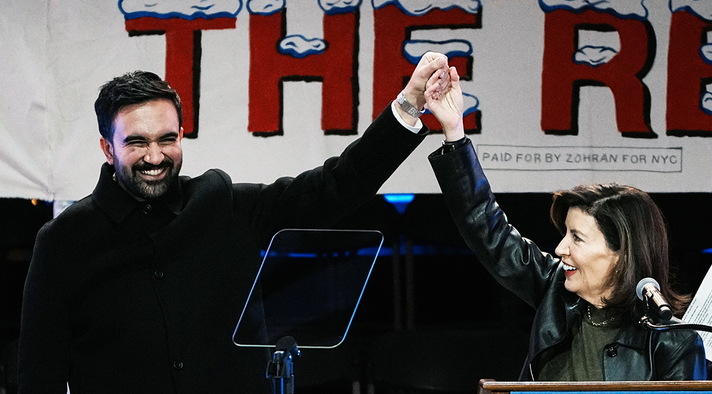
Mamdani, who appeared alongside Hochul at the conference, welcomed the governor’s willingness to reconsider her position. The democratic socialist mayor reaffirmed his commitment to increasing taxes on wealthy residents, portraying the proposal as a way to finance government services and expand economic assistance for working families.
The mayor has previously proposed raising New York City’s personal income tax rate on residents earning more than $1 million annually by two percentage points. He has also advocated increasing the state’s corporate tax rate from 7.5% to 11.5%, proposals that would require approval from state lawmakers and the governor.
The political relationship between Hochul and Mamdani has strengthened considerably over the past year. Despite earlier disagreements over taxation and economic policy, the two Democrats formed an alliance that helped Hochul secure a commanding reelection victory over Republican challenger Bruce Blakeman. Hochul won by approximately 20 percentage points, giving her another four years in Albany.
Their partnership has already produced substantial state funding for Mamdani’s childcare initiative. New York committed $1.2 billion to help launch free childcare for two-year-olds, with the program expanding to thousands of additional families across the five boroughs. The initiative is intended to eventually provide universal access, regardless of household income.
However, the program’s long-term financing remains unresolved. Existing state commitments are expected to support the initiative through 2028, leaving officials searching for a sustainable revenue source to maintain and expand the benefits. Hochul acknowledged that temporary funding would not be sufficient to guarantee the program’s future.
The governor said she intends to outline her approach in her 2027 State of the State address, although she has not identified specific taxes she would support. Her willingness to consider new revenue measures has nevertheless encouraged progressive activists who have spent months demanding that Albany increase taxes on high earners.
The Democratic Socialists of America have emerged as a particularly influential force in the debate. The organization’s New York City chapter has repeatedly called for higher taxes on wealthy individuals and corporations to finance childcare, housing initiatives, and other government programs. Its growing representation in the state Legislature could increase pressure on Hochul during upcoming budget negotiations.
DSA leaders have made clear that they intend to continue organizing demonstrations and lobbying lawmakers until their tax proposals receive serious consideration. The organization argues that wealthy residents should contribute more to public services, while business organizations have warned that additional taxes could undermine New York’s competitiveness.
The possibility of new taxes has also renewed concerns about the state’s already substantial tax burden. New York residents face some of the highest combined state and local income tax rates in the country, and business leaders have repeatedly cautioned that further increases could encourage companies and affluent taxpayers to relocate to lower-tax states.
That concern has been particularly relevant to New York’s competition with Florida, where residents pay no state personal income tax. Hochul herself previously acknowledged the risk of losing additional wealthy New Yorkers to places such as Palm Beach, recognizing that high-income residents contribute significantly to the state’s tax base.
Mamdani and his socialist allies have maintained that increasing taxes on the wealthy is necessary to finance their broader affordability agenda. Their proposals extend beyond childcare to include expanded public services and other initiatives intended to reduce household expenses. The debate increasingly centers on whether those programs should be financed through additional taxation or changes to existing government spending.
Hochul’s latest remarks do not amount to a formal tax proposal, and no new increase has been approved. Nevertheless, her apparent willingness to reconsider a position she defended throughout the election campaign represents a significant political development as progressive lawmakers prepare for the next legislative session.
With Democrats retaining control of New York’s state government and socialist activists demanding more aggressive fiscal policies, the coming budget negotiations could determine whether residents and businesses face another round of tax increases. Hochul’s decision will also test whether her administration can balance Mamdani’s expensive policy ambitions against concerns about affordability, government spending, and the state’s long-term economic competitiveness.