
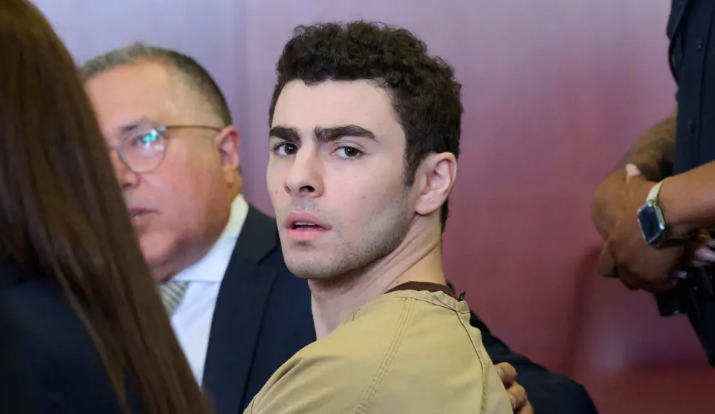
Lawyers for Luigi Mangione Move to Dismiss Key Charges in UnitedHealthcare CEO Assassination Case
Attorneys for Luigi Mangione have asked a federal judge in Manhattan to dismiss several charges tied to the high-profile assassination of UnitedHealthcare CEO Brian Thompson, including the only federal count that carries the possibility of the death penalty.
In court documents filed Saturday, Mangione’s legal team argued that federal prosecutors overstepped by charging him under a statute that permits capital punishment for killings committed with firearms during other violent crimes. The attorneys maintain that the alleged secondary offense—stalking—does not qualify as a crime of violence under federal law.
Mangione, 27, has pleaded not guilty to both state and federal charges in connection with the December 4 killing, which took place outside a Manhattan hotel just before Thompson was scheduled to speak at his company’s annual investor conference. The assassination triggered a multi-state manhunt that ended five days later when a tip led police to Mangione at a McDonald’s in Altoona, Pennsylvania—more than 230 miles away.
According to prosecutors, Mangione fled the scene on a bicycle, made his way through Central Park, then took a taxi to a bus terminal that serves various northeastern cities. Authorities said they found a backpack in his possession containing a firearm and ammunition, which investigators later linked to the shooting.
In Saturday’s filings, Mangione’s attorneys also asked the court to suppress both his statements to law enforcement and the contents of his backpack, claiming that he was questioned without being read his Miranda rights and that the bag was searched without a warrant. They allege these constitutional violations undermine the prosecution’s case.
The most serious charge Mangione faces is the federal count involving use of a firearm in a violent crime resulting in death—the only charge eligible for the death penalty. Although New York State does not allow capital punishment, the federal government can pursue it in certain circumstances.
In April, U.S. Attorney General Pam Bondi ordered prosecutors to seek the death penalty, calling the murder a “premeditated, cold-blooded assassination that shocked America.”
Mangione’s legal team previously challenged Bondi’s remarks, claiming they tainted the case and urging the court to disallow the death penalty altogether. Saturday’s motion expands on that argument by targeting the foundation of the charge itself, asserting that prosecutors have not clearly defined the “underlying crime of violence” required to sustain the firearm-related murder charge.
The defense’s position is that “stalking” — the alleged predicate offense — does not meet the threshold of a violent crime as required under federal law, and therefore the charge must be dropped.
The murder stunned the corporate world and ignited intense scrutiny of the health insurance industry. Authorities said the ammunition recovered at the crime scene had the words “delay,” “deny,” and “depose” written on it—phrases that critics often associate with insurance claim denials and policyholder frustrations.
While no motive has been formally established by prosecutors, the markings on the ammunition and Mangione’s apparent planning have fueled speculation about whether Thompson’s role in the healthcare industry made him a target.
Mangione remains held without bail as he awaits trial. A ruling on the dismissal motion is expected in the coming months.