
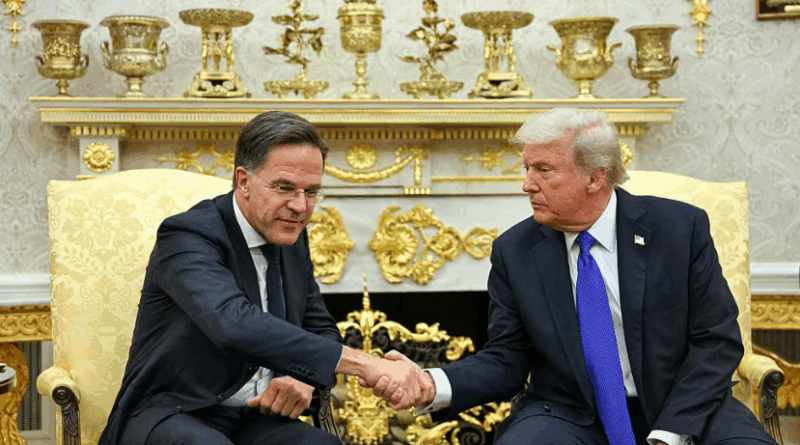
NATO Chief Backs Trump’s Iran Operation, Praises President For Degrading Tehran’s Nuclear Program
NATO Secretary General Mark Rutte praised President Trump’s military campaign against Iran on Thursday, calling the operation critical to degrading Tehran’s nuclear capabilities even as several European leaders have distanced themselves from the strikes.
“What the US did is crucial,” Rutte told reporters during a roundtable interview. “I commend the president for doing that.”
Rutte said both last year’s Midnight Hammer strikes on Iran’s nuclear facilities and the recent military campaign, known as Operation Epic Fury, played an essential role in weakening Iran’s nuclear program.
“This whole operation, Epic Fury, and the bombing last year is all part of degrading the nuclear capability,” Rutte said. “Which is crucial for Europe; crucial for, of course, the Middle East.”
His comments contrasted sharply with criticism from several European leaders who opposed Trump’s military approach toward Iran or refused to assist the United States during the conflict. Some NATO members declined to allow the US to use military bases or airspace for portions of the campaign.
Spanish Prime Minister Pedro Sánchez, for example, had previously condemned the operation as “illegal, reckless and unjust,” arguing the West could not “play Russian roulette with the destiny of millions of people.” Spain also blocked certain US war-related flights from using its airspace during the conflict.
Despite those disagreements, Rutte argued Europe still played an important supporting role.
“More generally speaking, Europe functioned as the power projection platform of the US,” he said, pointing to thousands of American military sorties launched from European bases.
Rutte also credited Trump with pushing NATO allies to significantly increase defense spending after years of falling short of alliance commitments.
“I would say largely thanks to this president,” Rutte said. “I credit him for this.”
The NATO chief also discussed Trump’s evolving relationship with Ukrainian President Volodymyr Zelensky, noting the president recently described the Ukrainian leader as “courageous.”
Rutte suggested Trump’s warmer tone reflected recognition of Ukraine’s recent military successes against Russia.
“I think what the president also acknowledged … is that the Ukrainians are doing quite well,” Rutte said.
He highlighted successful Ukrainian strikes against Russian oil refineries and military targets deep inside Russia while arguing Moscow continues suffering heavy battlefield losses.
“The Russians are losing now what the Soviets lost in 10 years in Afghanistan,” he said.
According to Rutte, Russian forces have largely stalled on the battlefield, with Ukraine even reclaiming territory in certain areas.
“The Russians stopped making big advances,” he said. “There’s even some talk of the Ukrainians getting back some of the territory from the Russians.”
At the same time, Rutte emphasized that Ukraine remains heavily dependent on Western military support, particularly Patriot air defense systems and missile interceptors supplied by the United States and funded by European allies.
He also rejected suggestions that the Trump administration has shifted its attention away from Ukraine because of negotiations with Iran.
“The president himself, but also [Secretary of State Marco] Rubio and [Special Envoy Steve] Witkoff and [Jared] Kushner” remain actively engaged in diplomatic efforts, Rutte said.
Instead, he argued, the primary obstacle to peace remains Moscow’s unwillingness to negotiate.
“The problem is that Putin is not playing ball,” Rutte said. “The only one willing to sit down is Zelensky. Zelensky is willing to sit down with Putin, sit down with anyone to get to a deal.”
“Putin is not serious so far, because he’s only repeating his maximalist demands,” he added.
“I don’t think it’s a lack of focus,” Rutte concluded regarding the administration’s efforts. “It is absolutely part of the fact that the Russians are not really involved.”