
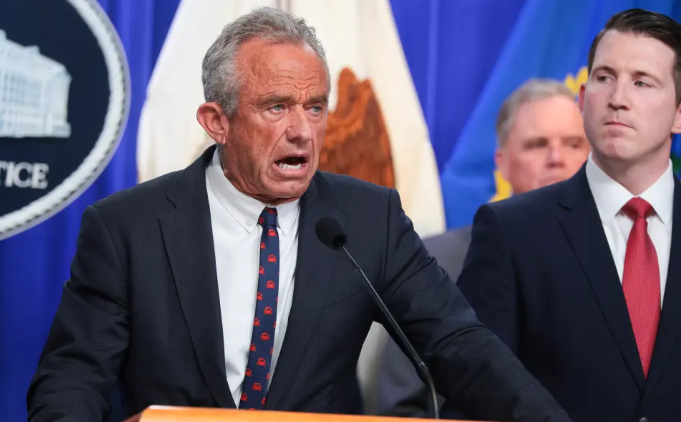
RFK Jr. Fires Back at Sen. Bill Cassidy Over Broken Promises Claim: “I’ve Kept Them All”
Health and Human Services Secretary Robert F. Kennedy Jr. pushed back Monday against accusations from Sen. Bill Cassidy that he broke commitments made during his confirmation process, insisting he has honored every promise he made.
“I went through every promise that I made to them and I’ve kept them all,” Kennedy said during an interview with NewsNation.
“I won’t speculate as to why Senator Cassidy is saying those things. I think anybody can make that speculation. But what he’s saying is not true.”
Cassidy, a physician and chairman of the Senate Health, Education, Labor and Pensions Committee, said during an appearance on CBS News’ “Face the Nation” that Kennedy had violated agreements related to vaccine policy and public messaging.
The dispute centers in part around language appearing on the Centers for Disease Control and Prevention website regarding vaccines and autism.
The CDC website currently states that the claim that “vaccines do not cause autism” is not considered an evidence-based statement because researchers have not ruled out every possible connection between vaccines and autism.
At the same time, the webpage contains a headline stating that vaccines do not cause autism, creating confusion over the agency’s official position.
Cassidy argued that the language violated assurances Kennedy provided during his confirmation hearings.
“I can tell you that that broken agreement that I had with the secretary, that that was not supposed to happen,” Cassidy said.
“So, once you lose trust in somebody, you’re not quite sure what to trust going forward.”
The Louisiana Republican also argued that public health policy must be built on trust and scientific evidence.
Kennedy has long been one of the country’s most prominent vaccine skeptics, making his nomination to lead the Department of Health and Human Services one of the most controversial cabinet confirmations of President Trump’s administration.
Despite those concerns, Cassidy ultimately voted to advance Kennedy’s nomination out of committee and later supported his confirmation on the Senate floor.
Cassidy explained that his decision was based partly on securing what he described as “guardrails” around Kennedy’s authority and public health policies.
Among those commitments, Cassidy said, was an agreement that Kennedy would continue operating within existing vaccine approval and safety monitoring systems.
Since taking office, Kennedy has made major changes at federal health agencies, including replacing members of the CDC’s vaccine advisory committee with new appointees.
Cassidy lost his bid for reelection earlier this year and is expected to leave the Senate when his term expires in January.