
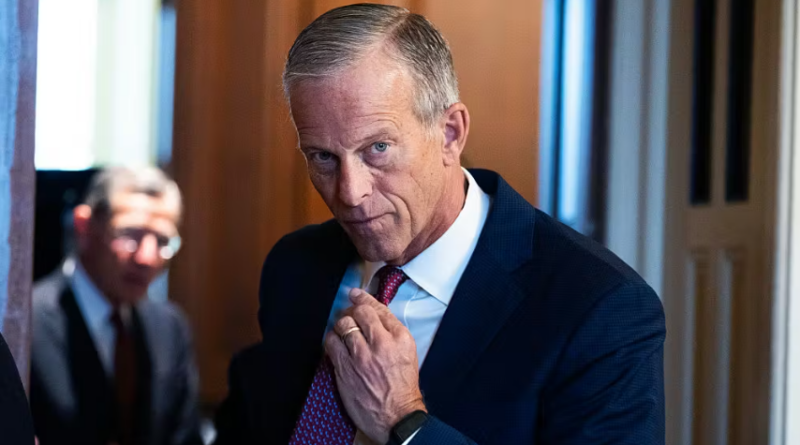
Senate Republicans Reelect John Thune as Leader Despite Conservative Revolt Following Devastating Midterm Defeat
Senate Republicans voted Tuesday to retain John Thune of South Dakota as their leader despite an internal revolt led by Wisconsin Sen. Ron Johnson, who demanded that the party reconsider its leadership following last week’s devastating midterm election losses. The decision keeps Thune at the head of the Republican conference as Democrats prepare to take control of the Senate in January.
Thune secured another two-year term after Republicans spent much of Tuesday holding closed-door discussions about the party’s future. The South Dakota senator faced no formal challenger, but several conservative lawmakers argued that the conference should delay its leadership elections until members had thoroughly examined what went wrong during the midterms.
The dispute came after Republicans lost at least seven Senate seats in the November 3 elections, surrendering the majority they had held during the first two years of President Trump’s second administration. The losses have triggered disagreements over the party’s legislative strategy, economic messaging, and relationship with the White House.
Johnson emerged as the leading voice demanding a delay, arguing that Republicans could not simply continue operating as though the election results had not fundamentally changed their political circumstances.
The Wisconsin Republican circulated a letter among his colleagues requesting additional time for the conference to evaluate its leadership and develop a strategy for recovering from the defeat.
Johnson secured support from several conservative senators, including Mike Lee of Utah, Rick Scott of Florida, John Kennedy of Louisiana, and Ted Budd of North Carolina.
Their effort forced Republicans to hold an extended discussion before proceeding with the scheduled leadership elections.
Johnson maintained that the conference needed to examine its failures before deciding whether the same leadership team should remain in place.
“We need to have some real soul-searching,” Johnson told reporters ahead of the meeting.
He argued that Republicans could not continue conducting business as usual after losing control of the Senate, warning that such a significant defeat required meaningful changes.
The Wisconsin senator also acknowledged that no obvious alternative to Thune had emerged, creating a difficult situation for lawmakers who wanted to reconsider the party’s direction without having another candidate prepared to assume leadership.
Republicans ultimately voted 31-15 against delaying the leadership election, clearing the way for Thune to retain his position.
Johnson left the meeting after his effort failed, while the remaining senators proceeded with the leadership vote.
Thune was subsequently reelected without opposition, securing the conference’s backing despite the frustration expressed during the day’s discussions.
The South Dakota Republican thanked his colleagues for their continued confidence and said he appreciated the opportunity to have an open discussion about the party’s future.
Thune pledged to maintain Republican unity while continuing to advance conservative priorities, cooperate with President Trump, and oppose Democratic legislative proposals.
His reelection means he will transition from Senate majority leader to minority leader when the 120th Congress begins on January 3, 2027.
The change will substantially reduce Republicans’ control over the Senate’s legislative agenda, committee operations, and confirmation process.
The party’s internal debate was not limited to Johnson. Missouri Sen. Josh Hawley also questioned whether Republicans should immediately retain their existing leadership after suffering such substantial losses.
Hawley argued that losing at least seven Senate seats should force the conference to reconsider its approach rather than simply approve the same leadership structure.
He expressed frustration that Republicans had not placed greater emphasis on affordability and the financial pressures facing American families during the election campaign.
Hawley suggested that the party needed to examine its own decisions instead of assigning responsibility entirely to outside political circumstances.
West Virginia Sen. Jim Justice also acknowledged that Republicans had legitimate reasons to question whether the same leadership team should remain in place.
Justice emphasized that the election results warranted serious consideration, although he stopped short of blaming Thune personally for the losses.
Other Republicans defended the South Dakota senator, arguing that he had maintained strong relationships within the conference and successfully managed a difficult legislative environment.
Oklahoma Sen. Jim Lankford said Thune enjoyed widespread support among Republican senators and noted that leading the conference required navigating competing priorities and complicated procedural rules.
North Dakota Sen. Kevin Cramer indicated that much of the internal discussion focused on the party’s broader problems rather than direct criticism of Thune.
Johnson himself later clarified that his effort was not intended as a personal attack on the Republican leader.
He argued that Thune had been unfairly criticized by some conservatives and maintained that his principal concern was the party’s need to reassess its political strategy.
The leadership dispute nevertheless exposed divisions over how aggressively Senate Republicans should pursue President Trump’s agenda.
During the past two years, Thune has helped advance major administration priorities involving taxes, border security, defense spending, and presidential nominations.
Republicans have also clashed over Senate procedural rules, particularly the legislative filibuster and its effect on the administration’s ability to pass certain measures.
President Trump repeatedly urged Senate Republicans to advance election legislation, including the SAVE America Act, which would impose additional citizenship verification requirements for federal voter registration.
Thune resisted demands to eliminate the filibuster to pass the legislation, arguing that Republicans lacked the necessary votes and that changing Senate rules could create consequences when Democrats eventually regained power.
That disagreement generated criticism from some conservatives who believed Senate leadership should have pursued a more aggressive legislative strategy.
Despite those tensions, Trump has generally maintained a working relationship with Thune.
Speaking Monday before the leadership election, the president described the South Dakota senator as a very fine man while emphasizing that Senate Republicans were responsible for choosing their own leader.
Trump did not publicly endorse an alternative candidate or call for Thune’s removal.
The president’s position helped distinguish the Senate leadership contest from the House Republican race, where lawmakers selected Ohio Rep. Jim Jordan to lead their conference after Speaker Mike Johnson declined to seek another leadership term.
Jordan’s election represents a change in House Republican leadership, while Senate Republicans have chosen continuity under Thune.
Both leaders will face the challenge of coordinating with the Trump administration while operating in the congressional minority.
The party’s election losses have created additional questions about how Republicans should approach the remaining two years of Trump’s presidency.
Several Republican senators have identified rising living costs, gasoline prices, and the conflict with Iran as important factors behind the party’s defeat.
Kentucky Sen. Rand Paul argued that economic concerns played a major role in the results and cautioned against assuming that changing congressional leaders would automatically address voters’ frustrations.
Paul emphasized that Americans were responding to financial pressures rather than simply casting ballots based on their opinions of Senate leadership.
Thune has also acknowledged that affordability must become a central Republican priority.
In remarks following the election, he described the results as a difficult setback and said the party needed to reflect on how it could improve its message to voters.
He argued that Republicans should intensify their focus on the cost of living while continuing to defend the policies enacted during their majority.
The election results have also placed pressure on lawmakers to complete unfinished business before Democrats assume control in January.
Republicans are considering how to advance remaining legislative priorities, including government funding and defense-related measures, during the final weeks of the current Congress.
Some senators have urged Thune to keep the chamber working for extended hours to complete as much of the Republican agenda as possible before the transition.
The leadership decision comes as President Trump faces the prospect of divided government for the remainder of his second term.
Democrats will control both chambers of Congress, giving them greater authority over legislative scheduling, committee investigations, and oversight of the executive branch.
Republicans will retain the ability to influence legislation through Senate procedural rules and bipartisan negotiations, but they will no longer possess the majority needed to direct the chamber’s business.
Thune has indicated that he remains willing to cooperate with Democrats on issues where the parties can reach agreement.
However, he has also pledged to resist Democratic proposals that conflict with Republican priorities, particularly policies involving federal spending and expanded government programs.
His challenge will be maintaining unity among Republican senators who hold differing views about the party’s direction.
Some members want a more confrontational approach to Democratic leadership, while others believe Republicans must focus on economic issues and demonstrate that they can deliver practical results.
Johnson’s unsuccessful effort to delay the election demonstrated that those disagreements remain unresolved, even though Thune retained broad support within the conference.
The Wisconsin senator’s criticism also reflected frustration among conservatives who believe Republicans missed opportunities while controlling the White House and Congress.
With Democrats preparing to take power, the party will have fewer opportunities to enact legislation without bipartisan support.
Thune’s reelection provides continuity at the top of the Senate Republican conference, but it does not eliminate the broader debate over the GOP’s future.
The party must now determine how to respond to its midterm losses, maintain its relationship with President Trump, and prepare for the next election cycle.
For Thune, the immediate priority will be keeping Republicans united while completing the remaining legislative business of the current Congress.
His colleagues have given him another term as leader, but Tuesday’s extended discussions demonstrated that many Republicans expect changes in strategy following the party’s defeat.
As the Senate prepares for Democratic control, Thune will remain responsible for guiding Republicans through a new political environment while addressing the concerns raised by Johnson and other members of the conference.