
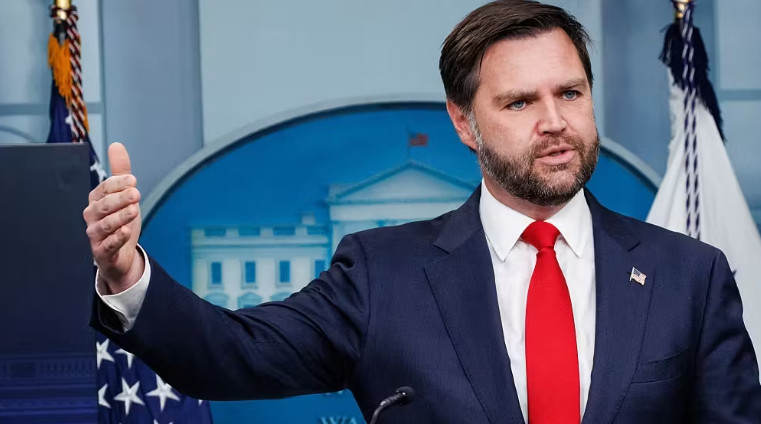
Strait of Hormuz Oil Flow Returns to Pre-War Levels, JD Vance Says
Vice President JD Vance said Tuesday that oil shipments moving through the Strait of Hormuz have recovered to pre-war levels following the US-Iran memorandum of understanding that reopened the strategic waterway.
“The strait is open in the sense that we’re seeing more oil come out of the strait — and some days even more oil than came out before the war even started,” Vance said during an interview on The Michael Knowles Show.
While oil exports have rebounded, Vance acknowledged that total maritime traffic through the strait remains below normal levels.
Before the conflict, roughly 130 to 150 vessels passed through the Strait of Hormuz each day. Last week, according to Lloyd’s List data, approximately 240 ships transited the strait during the entire week.
“What the cynics will say is, ‘well, if you look at the number of ships that are trafficking, that’s actually down from the pre-war start,’ but they’re mostly talking about cargo ships and other vessels,” Vance said.
“At least so far, what we’ve seen is the oil traffic has reached its pre-war height.”
Prior to the conflict, an estimated 20 million barrels of crude oil and petroleum products passed through the Strait of Hormuz every day, accounting for roughly one-quarter of the world’s seaborne oil trade.
Industry experts have noted that oil tankers have returned to the route more quickly than container ships, bulk carriers and other commercial vessels, many of which remain cautious about operating in the region following months of conflict.
Another factor behind the increase in oil shipments has been the easing of restrictions on Iranian energy exports as part of the broader US-Iran agreement, which included reopening the strait after it remained closed for months during the fighting.
The Strait of Hormuz remains one of the world’s most important energy chokepoints, serving as the primary export route for major oil producers including Saudi Arabia, Iraq, Kuwait, the United Arab Emirates and Qatar.
The reopening of the waterway has contributed to lower energy prices following sharp increases during the conflict. Brent crude was trading near $73 per barrel Tuesday, while West Texas Intermediate crude hovered around $70 per barrel, down significantly from wartime highs that approached $120.
“The world oil economy is kind of getting back into gear, that’s going to take a little bit of time, but you’ve already seen the prices come way down,” Vance said.
The vice president also criticized Republican voices who favored continuing military operations against Iran after the cease-fire agreement.
“Their attitude is just drop bombs and drop bombs and drop bombs, and they can’t really articulate to what end,” Vance said.
“What the president is saying is ‘I’m willing to drop bombs’ — and he’s clearly shown that he’s willing to drop bombs — ‘but only if it serves an objective.'”
Vance argued that the administration’s strategy has reduced pressure on global energy markets while preserving leverage over Iran during ongoing negotiations.
“So what he’s doing right now is taking a lot of pressure off of the world economy while not giving up a single one of his gains, and while preserving a lot of optionality,” Vance said. “I think that’s a very good place for us to be in, but there’s uncertainty because no one can be certain what the Iranians want to do.”