
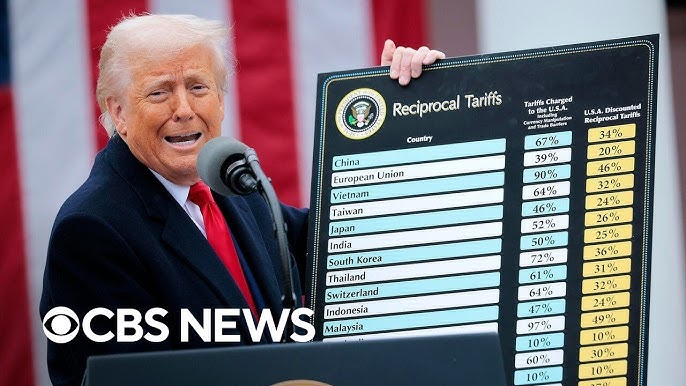
Trump Announces Tariff Hikes on Pharmaceuticals, Furnishings, Trucks, and Semiconductors
President Trump announced a future policy shift on his Truth Social platform, indicating significant changes to tariffs on pharmaceutical products effective from October 1st, 2025. His proclamation emphasizes that only those companies actively constructing manufacturing plants within US borders would be exempt from an intended 100% Tariff on patented or branded pharmaceuticals. Elaborating on his statement, the term ‘actively constructing’ is specifically defined as either having broken ground on the new facility or currently having a plant under construction.
Many publicly traded pharmaceutical giants such as AstraZeneca (AZN), Bristol Myers (BMY), Eli Lilly (LLY), GSK (GSK), Johnson & Johnson (JNJ), Merck (MRK), Novartis (NVS), Pfizer (PFE), Roche (RHHBY), and Sanofi (SNY) could be affected by this shift in tariff policy. The President’s message projects protection of local manufacturing and domestic pharmaceutical industry as the driving force behind this change.
Deeper tariff adjustments are also surging within the sectors of kitchen and bathroom furnishings, brought to light by the President’s Truth Social post. Beginning October 1st, 2025, tariffs of 50% will be levied on kitchen cabinets, bathroom vanities, and related products. Beyond this, a 30% tariff will be introduced on upholstered furniture, which the administration claims to be a response to an unfair influx of these products from abroad.
The administration points towards a necessity to uphold National Security and safeguard the domestic manufacturing process as the primary reasons behind such drastic measures. Key players in the market – Home Depot (HD), Lowe’s (LOW), Beyond (BYON), Bath & Body Works (BBWI), Wayfair (W), and others – are all businesses that could be directly impacted by these impending tariffs.
In a similar vein, protective measures are extended to the heavy truck manufacturing sector as unveiled by the President on Truth Social. A significant 25% tariff is to be imposed on all ‘Heavy (Big!) Trucks’ manufactured globally, outside the United States, commencing October 1st, 2025. The aim of these measures is to protect indigenous manufacturers like Peterbilt, Kenworth, Freightliner, Mack Trucks.
The administration posits this policy move as vital towards sustaining the financial health and stability of American truckers and assuring their protection from international competition. Besides the apparent economical motives, National Security purposes stand as an important factor behind the implementation of these tariffs. Such measures could potentially impact global manufacturers like Paccar (PCAR), Daimler Truck (DTRUY), Mercedes-Benz Group (MBGYY), Volkswagen (VWAGY), and Volvy (VLVLY).
On a different note, President Trump has recently promoted a disputed theory regarding the use of Tylenol in pregnant women. He boldly asserts a potential connection between this common drug used for pain relief and the occurrence of autism, despite the lack of conclusive scientific proof to bolster this claim. He urged citizens to refrain from using the medication until further studies can verify or refute these associations.
According to an official statement issued by the President’s office on the matter, numerous studies have indeed suggested a link between acetaminophen (the active ingredient in Tylenol) and autism. However, a causative relationship is yet to be incontrovertibly established due to conflicting evidence. It’s interesting to note that Tylenol is currently manufactured by Kenvue (KVUE).
Simultaneously, semiconductor produce has caught the Trump administration’s attention as well. In attempts to minimize dependence on foreign supply chains, Trump’s administration plans to request chip manufacturers to match their customer’s import volumes with domestic production. If companies fail to maintain this 1:1 ratio over time, they could potentially face imposing tariffs.
Publicly traded companies like AMD (AMD), Intel (INTC), Marvell (MRVL), Microchip (MCHP), Micron (MU), Nvidia (NVDA), Qualcomm (QCOM), and Texas Instruments (TXN) form the expansive landscape of semiconductor producers. This industry-wide objective, if actualized, poses extensive repercussions for all companies operating in this space.
Expressing interest in stake acquisition for strategic industry promotion, the Trump administration is now eyeing the energy industry – specifically the lithium mining sector. To that end, the administration is considering acquiring as much as a 10% equity stake in Lithium Americas (LAC). This move comes amidst renegotiation terms for the company’s $2.26B Energy Department loan for its Thacker Pass lithium project in Nevada, in association with automaker General Motors (GM).
The idea incites speculation as the Trump administration has previously acquired stakes in Intel (INTC) and MP Materials (MP) in a bid to spur industries it deems vital for national security. The shift of focus towards lithium production further suggests a drive for domestic energy security and resource self-sufficiency.
General Motors, holding a $625M, 38% stake in the Thacker Pass project, enjoyed direct negotiation with the Trump administration. Details of these discussions were provided to Reuters by individuals touched by the terms of the deal, emphasizing significance weighed heavily on lithium as a critical resource for the manufacturing of electric vehicle batteries.
The proliferating interest of the administration in various sectors underscores its attempt to regain control over the national economy. This strategy includes adopting strong protectionist measures, imposing higher tariffs on imports, and promoting domestic manufacturing and production. The long-term ramifications of these policies remain to be seen, necessitating close observation of these economic and political currents.
Regardless of possible criticism or contention, President Trump’s firm stances aim to claw back industries critical for national security, revitalize domestic manufacturing and protect local enterprises from globally-sourced competition. Whether these savvy maneuvers succeed in fortifying national security and economic stability amidst this shifting global trade equilibrium awaits future appraisal.