
Trump-Backed Byron Donalds Wins Florida Governor’s Race, Becomes State’s First Black Governor
Republican Rep. Byron Donalds made history Tuesday night, defeating Democrat David Jolly in Florida‘s gubernatorial election and becoming the state’s first Black governor. The victory extends Republican control of the governor’s office and delivers President Trump a major win in his adopted home state.
Donalds, 48, will succeed Republican Gov. Ron DeSantis, who is leaving office after serving two terms. His election also makes him the first Black Republican elected governor anywhere in the United States, a historic milestone for both Florida and the Republican Party.
The Associated Press called the race for Donalds following a competitive contest that became considerably closer than many Republicans initially expected. Unofficial results from Florida election officials showed Donalds receiving approximately 49.9% of the vote compared with 48.8% for Jolly.
Despite the narrow margin, Donalds successfully defended a governorship that Democrats have been unable to capture for more than three decades. His victory ensures that Republicans will continue directing Florida’s executive branch after eight years of conservative leadership under DeSantis.
President Trump played a prominent role in Donalds’ campaign, endorsing the congressman early in the election cycle and appearing alongside him at rallies during the final days before voting.
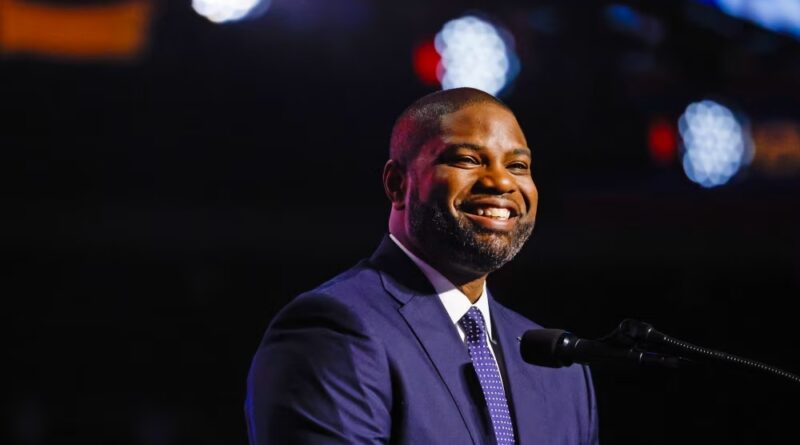
Donalds publicly thanked the president during his victory speech, crediting Trump’s support and emphasizing that Florida had once again chosen Republican leadership.
The incoming governor also praised DeSantis, promising to continue building on the policies that helped transform Florida into one of the nation’s most prominent Republican strongholds.
Donalds entered the race with a significant political advantage. Republicans held an estimated 1.5 million-voter registration lead over Democrats, reflecting the state’s dramatic political transformation over the past several election cycles.
Florida was once considered one of America’s most competitive battleground states, with presidential and statewide elections frequently decided by narrow margins.
That began changing as Republicans expanded their support among suburban voters, retirees and Hispanic communities. DeSantis accelerated the shift during his governorship, winning reelection in 2022 by nearly 20 percentage points.
Donalds campaigned on preserving those Republican gains while addressing economic concerns affecting Florida families.
His platform emphasized reducing property taxes, addressing rising homeowners insurance premiums, expanding educational opportunities and maintaining the state’s business-friendly environment.
Housing affordability and insurance costs became especially important issues throughout the campaign. Florida homeowners have faced substantial financial pressure from rising premiums, property expenses and the costs associated with hurricanes and other natural disasters.
Donalds argued that continued Republican leadership would provide a stronger foundation for addressing those problems without abandoning the state’s economic policies.
He also promised to expand school choice, giving parents greater flexibility in determining where their children receive an education.
On immigration, Donalds aligned himself with President Trump’s enforcement priorities, supporting stronger border security and cooperation between state and federal authorities.
The congressman also emphasized his personal background, frequently discussing his upbringing in Brooklyn, New York, and the financial challenges his family experienced.
Raised by a single mother, Donalds moved to Florida to attend college and later built a career in finance before entering politics.
He served in the Florida House of Representatives before winning election to Congress in 2020, representing a district in southwestern Florida.
Donalds became one of President Trump’s most recognizable congressional allies, frequently defending the administration’s policies and appearing in national media interviews.
His political career also reflects an unusual personal journey. Donalds was previously registered as a Democrat before moving toward conservative politics following the financial crisis of 2008.
That background became part of his appeal to voters who had reconsidered their own political affiliations.
During the gubernatorial campaign, Donalds also reached out to Black voters, arguing that Republican economic and educational policies could provide greater opportunities for families across Florida.
His Democratic opponent, David Jolly, presented a different political story.
Jolly, 54, previously served in Congress as a Republican before leaving the party and eventually registering as a Democrat in 2025.
He entered the governor’s race promising a more moderate approach to state government, arguing that Florida needed leadership focused on affordability rather than partisan political disputes.
Jolly concentrated heavily on housing expenses, insurance premiums, inflation and the expansion of artificial intelligence data centers.
He proposed a greater role for the state’s catastrophe insurance fund as part of his plan to address homeowners insurance costs.
Donalds favored continuing the private-market approach developed under DeSantis, while arguing that additional reforms could help reduce premiums.
The candidates also disagreed over the rapid expansion of data centers and their potential impact on electricity rates and local infrastructure.
Jolly advocated pausing certain data center construction projects, while Donalds favored greater local control and measures to prevent ordinary utility customers from bearing the costs of those facilities.
Despite Jolly’s effort to appeal to moderate and independent voters, he faced considerable organizational and financial disadvantages.
Donalds maintained a substantial fundraising lead throughout the campaign, allowing Republicans to invest heavily in advertising, voter outreach and campaign operations.
The Republican also benefited from endorsements by President Trump and DeSantis, giving him support from two of the most influential conservative figures in Florida politics.
Jolly attracted backing from prominent Democrats, including former Presidents Barack Obama and Bill Clinton, as his campaign attempted to make the race competitive.
The election became a major test of whether Democrats could regain political ground in a state that has moved increasingly toward Republicans.
Jolly campaigned in Democratic strongholds such as Broward County while also seeking support in traditionally Republican regions of central and northern Florida.
His efforts narrowed the contest, but ultimately fell short of ending the Republican Party’s longstanding control of the governor’s office.
The result also carries national political significance because Florida is President Trump’s home state and an important center of Republican political influence.
Donalds’ victory provides the president with a prominent political ally leading one of the country’s largest states during the final two years of his administration.
It also positions Donalds as a potentially influential national Republican figure.
As governor, he will oversee a state with more than 23 million residents and one of the largest economies in the United States.
He will inherit a government shaped by DeSantis’ policies on education, immigration, economic development and public safety.
Although Donalds has pledged continuity, his administration will face pressure to deliver measurable improvements on housing affordability, property taxes and insurance costs.
Those issues remained major concerns among Florida voters despite the state’s Republican registration advantage.
The relatively close election result also demonstrated that Democrats can remain competitive when economic concerns dominate the campaign.
Nevertheless, Republicans successfully preserved their control of Florida’s highest office, extending a winning streak that began in the 1990s.
For Donalds, the victory represents a historic political achievement and a significant promotion from Congress to the governorship.
For President Trump, it ensures that a close political ally will lead his home state while continuing many of the conservative policies established under DeSantis.
The election also marks a milestone in American political history, with Donalds becoming Florida’s first Black governor and the nation’s first elected Black Republican governor.
As he prepares to take office in January, Donalds will begin the transition from congressional lawmaker to chief executive of one of America’s most politically and economically influential states.