
Trump-Endorsed Republican Mike Rogers Refuses to Say Whether He’s MAGA During Heated NBC Interview
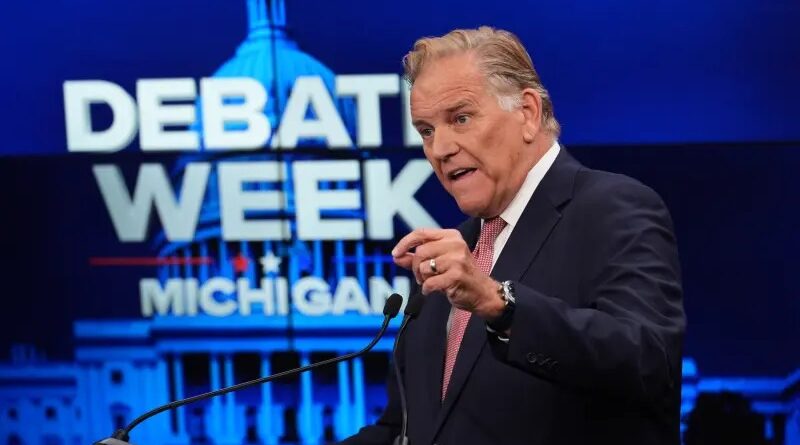
Michigan Republican Senate candidate Mike Rogers repeatedly refused to identify himself as a MAGA Republican during a contentious Sunday television interview, clashing with NBC host Kristen Welker just hours before appearing alongside President Trump at a campaign rally.
Rogers, a former congressman endorsed by Trump, was pressed several times about his political allegiance during an appearance on NBC’s Meet the Press. Rather than answer directly, the Republican candidate criticized the national media and redirected the conversation toward his Democratic opponent, Abdul El-Sayed.
The exchange highlighted the balancing act Rogers faces as he campaigns for Michigan’s open Senate seat, seeking support from Trump’s Republican base while attempting to appeal to independent voters and Democrats dissatisfied with their party’s nominee.
Welker initially asked Rogers whether voting for him would amount to supporting President Trump’s agenda.
Rogers appeared to have difficulty hearing the question, citing a problem with his earpiece before offering a broader response about his campaign.
“I’d say what a vote for me is, it’s a great day for the state of Michigan,” Rogers responded.
Later in the interview, Welker returned to the issue with a more direct question.
“Do you consider yourself to be a MAGA Republican?” she asked.
Rogers immediately objected to the direction of the interview.
“Listen, I’m going to tell you something,” he began. “I get you guys on the national press, but this is a little bit disgusting to me.”
Rather than address the MAGA label, Rogers criticized the media for what he described as insufficient coverage of Democrats who have refused to support El-Sayed.
He pointed to opposition from some Democratic figures and argued that his campaign has attracted voters from communities traditionally associated with the Democratic Party.
Welker interrupted, reminding Rogers that she was asking about his own political identity.
“Congressman, I’m asking you about you,” she said.
Rogers insisted that the political realignment occurring in Michigan was more important than the terminology being used to describe his campaign.
He claimed that Jewish Democrats and Black voters in Detroit, Pontiac and Flint were increasingly considering his candidacy because of concerns about El-Sayed.
Welker continued pressing him for a direct answer.
“Congressman, can you answer my question? Are you a MAGA Republican?” she asked.
“I’ve already answered the question, Kristen,” Rogers replied.
The NBC moderator challenged that response, pointing out that he had not actually identified himself as either a MAGA Republican or something else.
Rogers again declined to adopt the label, returning to his argument that Michigan voters were more interested in economic issues and their communities’ futures.
“There is a reason we have support from people in Detroit and Flint and Pontiac,” he said.
The former congressman accused El-Sayed of holding positions that alienate voters and invited national journalists to visit Michigan to speak directly with residents.
The interview came on the same day President Trump traveled to Port Huron to campaign for Rogers ahead of the November 3 midterm elections.
Trump has endorsed the former congressman and described him as a reliable Republican who would represent Michigan’s interests in Washington.
In a Fox News interview ahead of the rally, the president praised Rogers as someone who shares the values of Michigan voters.
“He’s going to be an amazing senator,” Trump said. “Solid as a rock. Apple pie.”
Rogers has welcomed Trump’s endorsement and emphasized that his relationship with the president could help him secure federal support for Michigan’s economy.
However, the Republican candidate has also publicly disagreed with certain administration policies, particularly tariffs affecting trade with Canada.
Michigan’s automotive industry depends heavily on cross-border manufacturing and supply chains, making trade restrictions a significant concern for businesses and workers.
Rogers has argued that tariffs should be evaluated according to their impact on Michigan jobs rather than treated as an all-or-nothing political issue.
During Sunday’s interview, he credited some of Trump’s trade policies with encouraging manufacturing investment while expressing reservations about tariffs affecting the automobile industry.
“The automobile portion of these Canadian tariffs worries me a little bit,” Rogers acknowledged.
He also pointed to manufacturing investments involving Chevrolet and Detroit Diesel as examples of economic activity he believes has benefited from the administration’s approach.
Rogers has previously called for an end to the broader trade dispute with Canada, including in campaign advertising directed at Michigan voters.
His position illustrates one of the differences between his campaign and the White House, even as he seeks to work closely with Trump.
The Senate race has become one of the most closely watched contests in the country.
Rogers is challenging El-Sayed, a progressive Democrat and former public health official, for the seat being vacated by retiring Democratic Sen. Gary Peters.
The Republican previously ran for Michigan’s other Senate seat in 2024, narrowly losing to Democrat Elissa Slotkin.
His latest campaign has focused heavily on economic issues, public safety and criticism of El-Sayed’s progressive political positions.
Rogers has also questioned El-Sayed’s associations with organizations he believes hold extremist views.
During Sunday’s NBC interview, Welker challenged Rogers over accusations involving the Muslim Brotherhood, an Islamist political movement founded in Egypt.
President Trump has accused El-Sayed of being connected to the organization, but those allegations have not been substantiated.
El-Sayed has denied membership or affiliation with the Muslim Brotherhood and criticized attempts to question his loyalty to the United States.
Rogers maintained that his concerns involved political ideology rather than religion.
“I wore the uniform of the United States, Kristen, so that people could vote any way that they want to in this country,” Rogers said.
“It’s not how you pray, it’s how you think,” he added.
The Republican nominee described El-Sayed as aligned with democratic socialist politics and argued that his policy positions would be harmful to Michigan.
Welker also asked whether Rogers agreed with rhetoric portraying his opponent as a violent terrorist.
Rogers rejected that characterization.
“I’ve never called him a terrorist,” he said.
He continued arguing that voters should examine El-Sayed’s political associations and policy proposals rather than focus on accusations of religious prejudice.
El-Sayed has accused Rogers and Trump of attempting to make his Muslim faith a campaign issue.
The Democrat, who was born in the United States to Egyptian immigrant parents, has emphasized his American identity and constitutional right to religious freedom.
The dispute intensified during the candidates’ final debate, when Rogers questioned whether El-Sayed’s political sympathies aligned with American interests.
El-Sayed called the questioning shameful and defended his commitment to the country.
The race has also attracted appearances from prominent national political figures.
Former President Barack Obama campaigned for El-Sayed in Detroit on Saturday, criticizing efforts to portray the Democratic nominee as less American because of his background.
Trump followed with Sunday’s appearance in Port Huron, emphasizing Republican turnout and attacking El-Sayed’s political positions.
The competing rallies demonstrate the importance both parties have placed on Michigan’s Senate contest.
Recent polling has shown a narrow race, with a RealClearPolitics average placing El-Sayed approximately 1.9 percentage points ahead of Rogers as of Sunday.
That figure represents an average of available surveys rather than an election result, and individual polls have varied.
Republicans are attempting to capture a Senate seat that Democrats have held for decades, while Democrats are working to retain the position as they seek to change the balance of power in Washington.
Rogers has emphasized outreach in Detroit, Flint and Pontiac, arguing that voters traditionally aligned with Democrats are increasingly willing to consider Republican candidates.
He has also pointed to disagreements within the Democratic Party following El-Sayed’s nomination.
The Democratic candidate defeated Rep. Haley Stevens in a contentious primary, exposing divisions between progressive and more moderate factions.
Rogers has attempted to use those divisions to build support beyond the Republican electorate.
His refusal to embrace the MAGA label during Sunday’s interview may attract additional scrutiny because of his close political relationship with Trump.
The former congressman has not withdrawn his support for the president, and Trump has continued publicly campaigning on his behalf.
Instead, Rogers has emphasized that his campaign is centered on Michigan’s economic interests and the specific concerns of voters in the state.
With Election Day approaching, the Republican nominee is seeking to maintain support from Trump’s coalition while presenting himself as a candidate willing to disagree with the administration on issues affecting Michigan.
Sunday’s interview made that approach particularly visible.
Despite repeated questions from Welker, Rogers never directly answered whether he considers himself a MAGA Republican, choosing instead to criticize national media coverage and focus on his Democratic opponent.
The exchange came just hours before he joined President Trump on the campaign trail, underscoring the political relationship at the center of one of the country’s most closely watched Senate races.