
Trump Orders South Korea Military Exercises Scaled Back to Protect ‘Good Relationship’ With Kim Jong Un
President Trump has ordered the United States to significantly scale back joint military exercises with South Korea, saying he was “not happy” that the drills were moving forward as he works toward another face-to-face meeting with North Korean leader Kim Jong Un later this year.
Trump said the exercises had been arranged too far in advance to cancel entirely, so he instructed Defense Secretary Pete Hegseth to substantially reduce their scope. The president pointed directly to his relationship with Kim as one of the reasons behind the decision.
“Based on my very good relationship with Kim Jong Un, of North Korea, I was not happy with the fact that the United States had, long ago, agreed to participate in Joint Military Exercises with South Korea,” Trump said. He added that because it was too late to cancel them altogether, he ordered Hegseth to dramatically cut them back.
The United States had already scrapped a joint amphibious landing exercise with South Korea that was scheduled for September. Trump’s latest intervention further reduces military activity that North Korea has repeatedly condemned as provocative preparation for a potential attack.
The move comes as Trump prepares for another potential meeting with Kim before the end of 2026. Trump confirmed last week that he intends to meet the North Korean leader, although an exact date has not been announced. Reports have suggested a meeting could potentially occur around Trump’s planned trip to Asia later this year.
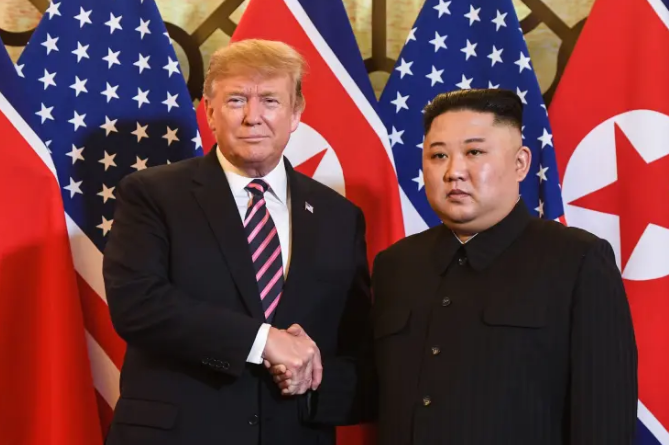
Trump has consistently argued that his personal relationship with Kim gives the United States an opportunity to prevent a major confrontation on the Korean Peninsula. The two leaders met three times during Trump’s first administration, including their historic 2018 summit in Singapore and their 2019 meeting at the Korean Demilitarized Zone.
North Korea, however, has not been satisfied by Washington’s decision to reduce the exercises. Kim’s sister, Kim Yo Jong, argued that shortening and shrinking the drills does not fundamentally change what Pyongyang considers their aggressive nature.
Trump also used his announcement to criticize South Korea over an entirely different foreign-policy dispute. He revealed that he recently asked South Korea’s president whether Seoul would participate in the American-led effort to denuclearize Iran and said the response was essentially “No thanks!”
That refusal appears to have added to Trump’s frustration with Seoul. The president has repeatedly complained that American allies have not contributed enough to the confrontation with Iran, even as the United States bears substantial military and financial costs.
South Korea also possesses significant stockpiles of sophisticated weapons and interceptors, including its Cheongung-II missile-defense system. Seoul has been reluctant to release some of those weapons even as the United States and other countries face pressure on their own supplies of advanced munitions.
Meanwhile, North Korea has strengthened its economic and military relationships with both China and Russia. Pyongyang has provided troops and weapons to Moscow for its war against Ukraine, while expanded trade with China and cooperation with Russia have helped boost North Korea’s economy.
Trump has long questioned the cost and strategic value of large-scale exercises with South Korea. During his first term, he similarly suspended or reduced military drills while pursuing diplomacy with Kim, arguing that the exercises were expensive and unnecessarily provocative.
With another Trump-Kim meeting potentially approaching, the president is once again betting that reducing military tensions can create room for direct diplomacy. His decision also makes clear that preserving his relationship with Kim is influencing how Washington approaches one of its longest-standing military alliances in Asia.