
Trump Warns France: Kill Tech Tax Or Face 100% Wine Tariffs: ‘I Have No Choice’
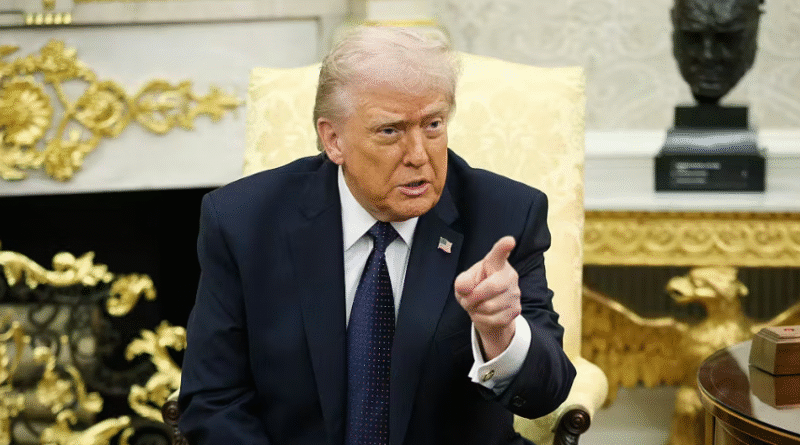
President Trump warned that France is at risk of a new trade war with the United States, declaring that unless Paris scraps its digital tax on American technology companies, his administration will have “no choice” but to impose 100% tariffs on French wines and champagne.
Trump said he delivered the warning directly to French President Emmanuel Macron, demanding that France eliminate its 3% digital services tax or risk devastating consequences in the American market, which accounts for roughly one-fifth of the French wine industry’s global sales and is worth more than $2 billion annually.
“I asked him not to charge American companies, and if they do, I have no choice but to charge a 100% tariff on all champagnes and all wines coming out of France,” Trump said. “All he has to do is get rid of the sales tax, and he wouldn’t have that kind of pressure.”
The ultimatum sets up a potential showdown at this week’s G7 summit in Évian-les-Bains, where leaders from the world’s wealthiest democracies are gathering to discuss global trade, security and economic policy.
Trump’s comments also undercut claims from Macron’s office last week that the two countries had quietly resolved their long-running dispute over France’s taxation of Silicon Valley giants.
A senior source close to the French president told reporters that the issue was “no longer up for debate” among G7 nations, though a US official quickly rejected that characterization as inaccurate.
France’s digital services tax, commonly referred to as the GAFAM tax, was enacted in 2019 and imposes a 3% levy on local revenues generated by companies including Google parent Alphabet, Amazon, Meta and Apple.
Because the tax targets gross revenue rather than profits, it disproportionately affects American technology companies and generated approximately $700 million last year, according to France’s finance ministry.
The dispute intensified in October when France’s National Assembly voted 296-58 to double the tax to 6% and lower the threshold to target only the largest global technology firms. The proposal was ultimately vetoed by government ministers.
Lawmakers had initially considered raising the tax to 15% before scaling back the proposal amid industry concerns. Then-Economy Minister Roland Lescure warned at the time that a “disproportionate” tax could trigger “disproportionate” American retaliation.
Trump’s latest warning revives the possibility of the same 100% tariff level first proposed by the US Trade Representative during a 2019 investigation into the French tax.
While Macron has previously been viewed as one of the few European leaders capable of reaching agreements with Trump, including securing an eleventh-hour truce during the 2019 G7 summit in Biarritz, the Trump administration has adopted a tougher stance toward foreign digital taxes.
White House spokesman Kush Desai pointed to a February 2025 presidential memorandum stating that American businesses would no longer “prop up failed foreign economies through extortive fines and taxes.”
The memorandum directed US Trade Representative Jamieson Greer and the Treasury Department to determine whether to reopen a formal investigation into France’s digital levy.
France’s position has increasingly isolated it from several allies that have retreated under pressure from Washington. Canada abandoned its own digital tax in 2025 after the United States suspended trade talks, while Italy is reportedly considering repealing its levy.
Britain, however, has retained its digital services tax under its current trade arrangement with the United States.
The G7 summit runs through Wednesday in the French lakeside town of Évian-les-Bains.
The Group of Seven consists of Canada, France, Germany, Italy, Japan, the United Kingdom and the United States. The bloc represents some of the world’s largest advanced economies and plays a major role in shaping global trade and financial policy.
Russia joined the group in 1998, creating the G8, but was suspended after its seizure of Crimea. China, despite having the world’s second-largest economy and population, has never been a member of the organization.