
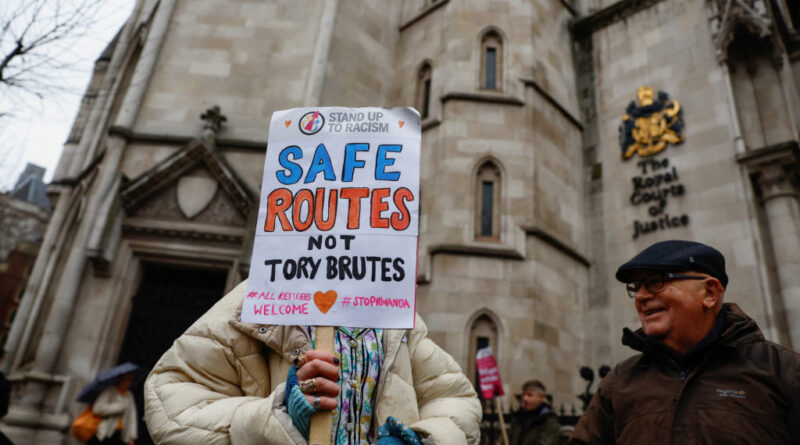
UK’s Undulating Stance on Asylum Policy Sparks Debate
Aggressive measures such as large-scale expulsions, detention facilities, and even the proposition of leaving international conventions on Asylum and Torture, have come under the spotlight in public debates. The possibility of the UK sending back asylum seekers to risky territories like Afghanistan and Eritrea, where their lives would be in danger, has caused quite an uproar. Nigel Farage, the leader of Reform UK, argues that while these issues are unfortunate, it’s not within the UK’s jurisdiction to address all global troubles. Recently, he has shifted his stance to focus on his party’s updated approach to tackle unlawful migration.
While previously Farage had avoided endorsing ‘large-scale deportations’, referring to them as ‘politically infeasible’, he now appears to have adopted an immigration narrative akin to that of former US President Trump. Such a policy was initiated by the previous Conservative government as a reaction to the persistent issue of housing shortage. Despite a lack of substantial progress on its pledge to stop it, the Labour Party has similarly found little success.
This issue has seen a noticeable shift in position among all principal parties, who have seemingly sided with more conservative views. There has been minimal political backlash against Farage’s rigorous propositions and the concept that the UK should cease to provide refuge to those who enter illegally. The Conservative party’s counter-argument has been merely that his ideas are recycled versions of their unexecuted ones prior to the general election.
The Labour Party posits that the redirected resources from the Home Office, released by this decision, have expedited asylum claim processing and heightened deportations. They posit that intensified action against predicate criminal organizations and the newly introduced ‘one-enter-one-leave’ agreement with France shall discourage people from making perilous trips across the Channel in smaller vessels, which are currently at an all-time high.
Instead of defending the principal idea of providing refuge to legitimate refugees, Angela Eagle MP, Labour’s border security minister, has expressed skepticism about the practicality of Farage’s policies. Even the Liberal Democrats have viewed these issues through a similar lens. Their critique primarily targets the lack of feasible solutions in Farage’s proposals.
The Liberal Democrats commented, ‘This plan perfectly encapsulates Nigel Farage as it, too, lacks concrete solutions.’ They further added, ‘While Farage fuels societal discord, we, the Liberal Democrats, are focused on serving our local communities.’ The task of preserving the principle of asylum largely falls upon the shoulders of the Refugee Council.
The Refugee Council’s CEO emphasised the historical undertone of the matter, saying, ‘Britain, along with its allies, resolved to protect those escaping persecution following the traumas of World War II.’ He reminded that the Refugee Convention encapsulates a vow against repetition of such atrocities, establishing a legal structure that ensures an unbiased chance to apply for asylum to those who seek safety on our shores.
Whether people are fleeing conflicts like those in Sudan or living under oppressive regimes like the Taliban, they continue to need protection. A fair, controlled system that can efficiently distinguish between those eligible for protection and those who are not, can meet this challenge, as per the Refugee Council.
However, with Reform enjoying a lead in the polls and public demonstrations occurring across the country, politicians of every hue face increasing demands to address public discontent over this issue. A recent survey reveals that half of the voters now believe that the past decade’s immigration has had a mainly adverse impact on the country, a figure that has doubled in the last three years.
Whilst there has been some headway in decreasing the expenses of asylum accommodation, the overall number of people housed this way has seen an increase of 8% since Labour assumed control, fuelled by a rise in new claims. But the ongoing efforts to terminate the use of asylum accommodations have evidently hit a wall.
This presents a gap in credibility that Farage appears to be willing and prepared to capitalize on. The failure of the current efforts and public sentiment around immigration has created a situation that could have far-reaching implications. Reform UK’s implementation of a stringent approach toward this issue can potentially reshape the national and political landscape pertaining to immigration and asylum policy.