
US, Iran ‘Already Signed The Deal Digitally’ Sunday, Vance Says
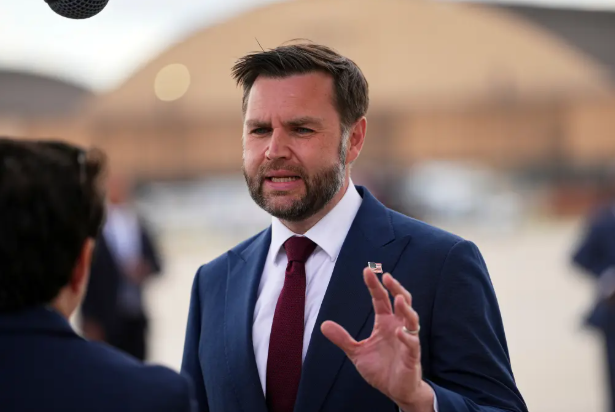
Vice President JD Vance claimed Monday that the United States and Iran have “already signed” a peace agreement aimed at ending their three-and-a-half-month war.
Vance said during an appearance on ABC’s “Good Morning America” that the agreement was signed “digitally” ahead of a formal signing ceremony scheduled to take place Friday in Switzerland.
It was not immediately clear whether Vance was referring to the final peace agreement itself or to a preliminary memorandum of understanding or framework agreement between the two sides.
Still, the revelation that a document has apparently already been signed raises several questions, including why the text has not yet been publicly released, whether the digital signing triggered the reopening of the Strait of Hormuz and the lifting of the US naval blockade on Iranian ports, and whether the anticipated 60-day technical negotiation period has already begun or will instead commence following Friday’s ceremony.
Vance said the text of the agreement would be released later this week.
President Trump, who previously indicated that the Strait of Hormuz would reopen Friday, is expected to discuss the logistics of demining the critical waterway during meetings with G7 leaders in France this week.
“Ships are starting to move, many loaded up with Oil, out of the Strait of Hormuz,” Trump wrote on Truth Social Monday morning.
Vance spent Monday morning making the rounds on major television networks to urge caution regarding reports emerging from Iran about the contents of the agreement and to respond to concerns from some Republicans over reports that Tehran could gain access to reconstruction funds.
The vice president confirmed that Iran could potentially receive access to a $300 billion reconstruction fund if it fulfills its obligations to end its nuclear program, though he emphasized that none of the money would come from the United States.
“That’s the sort of thing they could have access to, funded by the Gulf Cooperation Council, so long as they honor their end of the obligation,” Vance said during an appearance on “CBS Mornings.” “We absolutely are open to the GCC countries investing in the reconstruction of Iran only if Iran ends their nuclear program.”
Vance also stressed on “Good Morning America” that “not a single dollar of American money will go to Iran” and emphasized that any economic benefits would only come after Tehran meets specific benchmarks related to ending its uranium enrichment program.
Sen. Lindsey Graham (R-SC), one of President Trump’s closest allies, has emerged as one of the most vocal critics of the reconstruction proposal, arguing that any financial aid would be ineffective without regime change in Iran.
“The idea of a $300 billion reconstruction fund, given who is in charge of Iran, seems to be tone deaf,” Graham wrote on social media. “It would be akin to a Marshall Plan for Germany with the Nazis still in charge.”
Vance pushed back on those concerns.
“I caution Lindsey Graham and anybody else not to believe the hard-liner propaganda in Iran, but to believe what’s actually in the agreement,” he said. “We’ll be releasing the text this week, and what everybody will see is that Iran doesn’t get a dime of money unless they perform their obligations. The money that we’re talking about is fundamentally sanctions relief. We’re not giving them American money.”
Significant questions remain about the implementation of the agreement, particularly concerning the future of the Strait of Hormuz and whether ships traversing the vital shipping lane could face fees.
Trump has insisted the waterway will remain permanently toll-free.
However, Iranian Foreign Ministry spokesman Esmail Baghaei suggested Monday that while Tehran would not impose tolls on vessels passing through the strait, the country could still charge fees “in exchange for the services that are provided.”
Vance acknowledged that substantial details still need to be worked out.
“There are a lot of very important details to figure out that we’re actually going to sit at the table and discuss together,” he said during an interview with CNBC.
“Our expectation is that the strait is going to be opened in a toll-free way for the long term,” Vance added. “And that’s the sort of thing that we’re going to figure out in these technical negotiations.”