
Canada PM Mark Carney Says Government Prepared for ‘Extreme’ Risk of US Military Action
Canadian Prime Minister Mark Carney revealed that his government has examined how Canada would respond to the possibility of U.S.-led military action, describing the scenario as an “extreme tail risk” that national leaders nevertheless have a responsibility to consider.
Carney discussed the issue during an interview conducted in New York while he was attending the United Nations General Assembly. Asked whether he had taken President Trump’s previous comments about Canada becoming the 51st state seriously, Carney confirmed that his government had studied the possibility of American military action.
Carney stressed that he does not consider a U.S. invasion a likely scenario. He characterized the preparations as basic risk management, saying leaders have a responsibility to examine even highly unlikely threats to their countries. He declined to provide specific details about what Canada’s preparations involved.
Trump has repeatedly discussed the possibility of Canada becoming part of the United States. In January 2025, however, he ruled out using military force to annex the country and instead said he would consider using “economic force.”
The disclosure comes amid heightened tensions between the neighboring countries. Trade negotiations collapsed in August, after which the United States imposed 50% duties on approximately $28 billion worth of Canadian goods and Canada responded with retaliatory tariffs in September.
Carney said his government is simultaneously working to reduce Canada’s dependence on the United States in strategically important areas. That includes examining alternatives to Elon Musk’s Starlink satellite network and reconsidering Canada’s planned purchase of a full fleet of American-made F-35 fighter jets.
Canada has been reviewing its planned acquisition of 88 F-35s from Lockheed Martin and considering alternatives, including Sweden’s Saab Gripen. Carney said factors such as military capabilities, strategic dependence and the economic benefits for Canada would influence the government’s eventual decision.
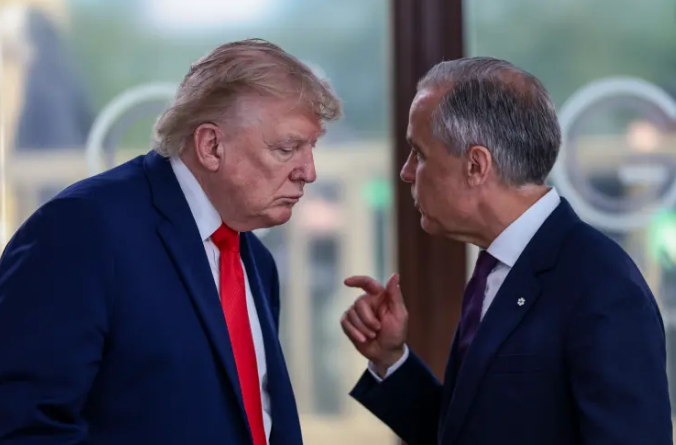
Despite the tensions, Carney said he and President Trump continue to communicate frequently. He said the two leaders have spoken multiple times since trade negotiations broke down and described their relationship as direct, allowing them to discuss disagreements while continuing to cooperate on other international issues.
Carney’s government has also been pursuing closer economic and strategic relationships with Europe and other international partners. He has presented that diversification as a way of reducing Canada’s vulnerability when critical technologies, military equipment or major parts of its economy depend heavily on a single country.
The prime minister’s comments do not indicate that Canada expects an American invasion. Instead, Carney described military contingency planning as preparation for an unlikely worst-case scenario while his government pursues a broader effort to reduce Canada’s strategic dependence on the United States.