
JD Vance Reveals He May Not Run for President in 2028 Despite Leading Republican Field
Vice President JD Vance has revealed that he may decide against running for president in 2028, acknowledging that family considerations could ultimately outweigh his political ambitions despite his prominent position within the Republican Party.
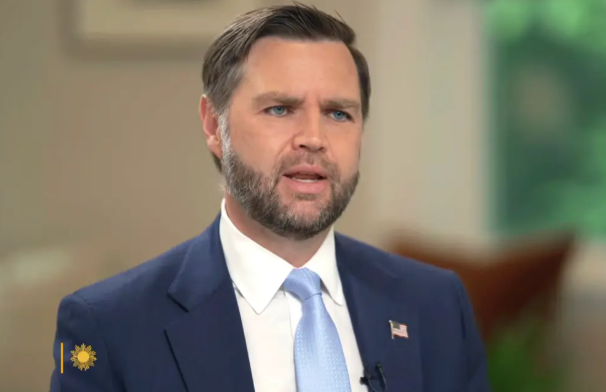
Vance made the admission during a CBS News town hall, where he was asked whether there was any possibility he would decline to seek the Republican presidential nomination after President Trump completes his second term.
“Of course there’s a chance,” Vance responded, making clear that he has not committed to entering the race.
The vice president pointed to his wife, Usha Vance, and their four young children as important considerations in a decision that could reshape the Republican presidential field.
“We’ve got four little kids, my wife has never loved politics. She loves public service,” Vance explained.
His comments come as Republicans increasingly discuss who will carry President Trump’s political agenda into the 2028 election.
Vance has emerged as a prominent potential successor, having served alongside Trump in the White House while becoming a leading advocate for the administration’s domestic and foreign policy priorities.
However, the vice president emphasized that the demands of another national campaign would require serious consideration by his entire family.
He also acknowledged that he has a tendency to delay major personal decisions rather than begin planning years in advance.
“The way that I think about life, big life decisions, my wife will tell you this: I’m a procrastinator. I hate thinking about it,” Vance said.
The vice president indicated that he intends to give the question more attention after the November midterm elections, rather than allowing speculation about 2028 to distract from his current responsibilities.
His immediate political focus remains helping Republicans maintain control of Congress and advancing President Trump’s legislative agenda.
Vance has spent considerable time traveling across the country on behalf of Republican candidates, appearing at campaign events and raising money for congressional races.
Those efforts have placed him at the center of the party’s midterm strategy while providing him with opportunities to strengthen relationships with Republican voters and officials.
The vice president has also become one of the administration’s most recognizable public representatives, frequently defending Trump’s policies during interviews and public appearances.
His position has naturally fueled speculation that he could seek the presidency when Trump leaves office.
President Trump has previously described Vance as his most likely political successor, although he has also praised Secretary of State Marco Rubio as another prominent Republican leader.
Trump has suggested that the two men could form a future presidential ticket, while declining to make a definitive endorsement for the 2028 nomination.
Early Republican primary polling has placed Vance ahead of other potential contenders.
According to the RealClearPolling average cited by the New York Post, Vance has approximately 39% support among Republican primary voters, giving him a 15-point advantage over Rubio.
Donald Trump Jr. ranks third in that polling average with approximately 11% support.
Those figures represent an early snapshot of Republican preferences more than two years before the election, rather than a settled presidential field.
No major Republican candidate has formally secured the nomination, and the political environment could change considerably before voting begins.
Vance’s comments also highlight the personal challenges facing political families, particularly those raising young children while living under constant public scrutiny.
The vice president and his wife welcomed their fourth child, a son named Alec, on July 19.
Their other children are Ewan, 9, Vivek, 6, and Mirabel, 4.
A presidential campaign would require extensive travel, fundraising, media appearances and public events, adding to the responsibilities the family already faces during Vance’s vice presidency.
Usha Vance has previously acknowledged that she does not approach politics in the same way as her husband.
During a March interview with NBC News, the second lady explained that her political opinions do not always fit neatly into traditional partisan categories.
“Sometimes I have thoughts that fit very comfortably into one side or another,” she said. “Sometimes I have views that are way more idiosyncratic.”
She also emphasized that her relationship with the vice president is personal rather than political, rejecting the idea that she serves as an informal member of his campaign or administration staff.
“I’m not his staffer. I’m not involved in this in any professional sense,” Usha explained.
She added that she and her husband do not agree on every political issue, describing herself as someone who offers an independent perspective.
Her comments provide additional context for Vance’s acknowledgment that family considerations will influence his eventual decision.
Earlier this year, Usha said the possibility of a 2028 presidential campaign was not an immediate priority for the family.
She suggested that questions about her husband’s political future would be easier to answer in 2027, after the administration had completed more of its current work.
Vance’s latest remarks appear consistent with that timeline.
Although the vice president has not ruled out running, he has repeatedly insisted that his attention remains on the responsibilities of his current office.
The question of who succeeds Trump has nevertheless become a significant subject within Republican politics.
Rubio has received attention for his work as secretary of state, particularly his involvement in negotiations and national security decisions concerning Iran.
Other Republicans, including Texas Sen. Ted Cruz, have also discussed the possibility of seeking the presidency.
Cruz and Vance recently exchanged public remarks about their respective political ambitions, illustrating how early the debate over the party’s future has begun.
Vance previously suggested that Cruz was already positioning himself for 2028, while Cruz accused the vice president of being insecure about potential competition.
Both men subsequently emphasized the importance of concentrating on the upcoming midterm elections.
For now, Vance remains a leading figure in discussions about the Republican Party’s future, but his latest comments demonstrate that a presidential campaign is not guaranteed.
The vice president has described public service as rewarding and has expressed pride in the work he has undertaken alongside President Trump.
At the same time, he has made clear that the decision to pursue the nation’s highest office involves more than political opportunity.
With four young children and a wife who has expressed reservations about political life, Vance faces a personal choice that he says remains unresolved.
His remarks leave Republicans with an important unanswered question as the party approaches the next presidential election cycle.
Vance has the national profile, administration experience and early polling support associated with a potential presidential campaign, but he is not yet prepared to make that commitment.
For now, the vice president says his focus is on serving in the Trump administration and helping Republicans through the November elections, with a decision about 2028 still to come.