
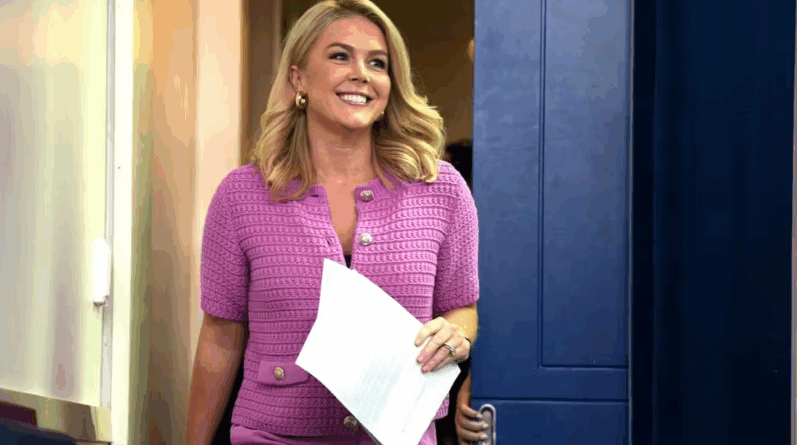
Karoline Leavitt Delivers Blunt Assessment of Katie Zacharia’s Five-Day White House Tenure
Former White House Press Secretary Karoline Leavitt has offered a candid assessment of Katie Zacharia’s brief and troubled tenure in the Trump administration, acknowledging that the demanding position simply was not the right fit for her successor.
Leavitt, who stepped down in August to focus on her family, addressed Zacharia’s departure during a Fox News interview Wednesday, just days after the replacement press secretary left the White House following only five days on the job.
The former spokeswoman made clear that the position requires an unusual combination of preparation, confidence and the ability to withstand intense scrutiny from reporters.
Leavitt said the job was “not for her,” referring to Zacharia, while also expressing goodwill toward the former White House official.
Her remarks came after a turbulent week in which Zacharia’s first press briefing drew widespread attention, questions emerged about her professional credentials and President Trump publicly suggested she reconsider the position.
Zacharia, a conservative commentator and longtime supporter of the president, was selected to replace Leavitt on October 9.
Her appointment initially generated enthusiasm among some conservative activists who welcomed the selection of another outspoken supporter of the administration.
However, her introduction to the White House briefing room quickly became a source of controversy.
During her October 13 debut, Zacharia appeared visibly nervous while delivering prepared remarks about the administration’s accomplishments.
The briefing lasted approximately 14 minutes, with the new press secretary taking questions from only three reporters before abruptly concluding the session.
One question involved whether the United States had stopped sharing intelligence with Ukraine, an issue of considerable importance amid President Trump’s efforts to negotiate an end to the war with Russia.
Zacharia told Fox News correspondent Peter Doocy that she would have to follow up with additional information.
She also mistakenly referred to her husband as her president before correcting herself, an awkward moment that circulated widely on social media.
The performance attracted criticism from political commentators and reporters who questioned whether she had received sufficient preparation for one of the most demanding communications positions in Washington.
An anonymous White House official warned shortly after the briefing that Zacharia needed to improve quickly or risk an exceptionally short tenure.
The official compared her situation to that of Anthony Scaramucci, who served as White House communications director for approximately 10 days during President Trump’s first administration.
Despite the criticism, several prominent conservatives defended Zacharia.
Turning Point USA spokesman Andrew Kolvet praised her willingness to conduct a briefing immediately after assuming the position, while acknowledging that she appeared nervous.
White House Communications Director Steven Cheung also defended her initial appearance, praising her presentation of the administration’s accomplishments.
President Trump initially offered an encouraging assessment.
“I thought she did excellent. She did very good,” the president told reporters following her debut.
However, the situation deteriorated as additional questions emerged about Zacharia’s background.
Reports revealed that she had previously described herself as a lawyer despite not being licensed to practice law.
Zacharia holds a law degree but reportedly did not pass the California bar examination.
The distinction became a significant issue because her public professional descriptions had suggested legal credentials that she did not possess.
Zacharia defended her background, pointing to her legal education and experience involving international legal matters.
The controversy added to the scrutiny surrounding her appointment and raised questions about the White House’s vetting process.
By October 16, President Trump was openly discussing whether Zacharia should remain in the position.
Speaking to reporters outside the White House, Trump said he had encouraged her to reconsider the job because of the intense criticism she was experiencing.
The president described the treatment she had received from the media as harsh and suggested that remaining in the role might not be worthwhile for her personally.
“I told her, ‘I think you’re better off being happy,'” Trump explained.
He also said he wanted Zacharia to enjoy her life rather than face constant public attacks.
Trump’s remarks indicated that he had serious reservations about whether the position was suitable for her, even while expressing personal sympathy.
Later that day, Zacharia announced her departure, bringing her tenure to an end less than a week after she officially began.
In a farewell message, she expressed gratitude for the opportunity to serve President Trump and continued to praise his leadership.
She described the president as gracious and hardworking, making clear that her departure had not changed her political loyalty.
Zacharia subsequently returned to California and has largely avoided media appearances.
Her brief tenure has now become the subject of renewed attention following Leavitt’s assessment.
Leavitt, who became the youngest White House press secretary in American history when she assumed the position in January 2025, spent approximately 17 months representing the administration.
During that period, she developed a confrontational approach to White House briefings, frequently challenging reporters over questions she considered misleading or unfair.
Her experience gave her firsthand knowledge of the pressure associated with serving as the president’s primary spokesperson.
The position requires extensive familiarity with domestic policy, foreign affairs, executive decisions and rapidly developing news stories.
A press secretary must also respond to unexpected questions while communicating the administration’s position accurately and consistently.
Leavitt’s comments reflected those demands, emphasizing that the role is difficult even for experienced political communicators.
Her assessment nevertheless generated disagreement among some of Zacharia’s supporters.
They questioned whether it was appropriate for a former White House official to publicly criticize a fellow Trump appointee who had received limited preparation time.
Reports indicate that Zacharia had only a short period to prepare before conducting her first briefing.
Her initial appearance came just one day after she officially started working in the position.
Some individuals familiar with the transition have suggested that the compressed schedule made an already challenging assignment considerably more difficult.
The White House has not announced a permanent replacement for Zacharia.
Leavitt remains involved in President Trump’s political operations and is reportedly assisting with the search for the administration’s next press secretary.
The White House is not expected to finalize the appointment before the November 3 midterm elections.
That leaves the administration navigating a particularly busy political period without a permanent official occupying one of its most visible communications positions.
Trump has frequently served as his own principal spokesperson, regularly answering reporters’ questions during White House appearances, campaign rallies and travel.
The president has also relied on senior administration officials to communicate policy developments and respond to major controversies.
Leavitt’s departure in August followed the birth of her second child and her decision to spend more time with her family.
Although she no longer occupies the press secretary position, she has continued participating in political activities associated with the president.
Her latest comments highlight the challenges facing whoever eventually assumes the role.
Zacharia’s experience demonstrated how quickly a high-profile White House appointment can unravel when public scrutiny, preparation and professional expectations collide.
Despite her brief tenure, Zacharia has continued expressing loyalty to President Trump and pride in having accepted the opportunity to serve.
Leavitt, meanwhile, has made clear that the White House press secretary position is not suited to everyone, even those who strongly support the president and his administration.
The search for a successor continues as the White House prepares for the final stretch of the midterm campaign.