
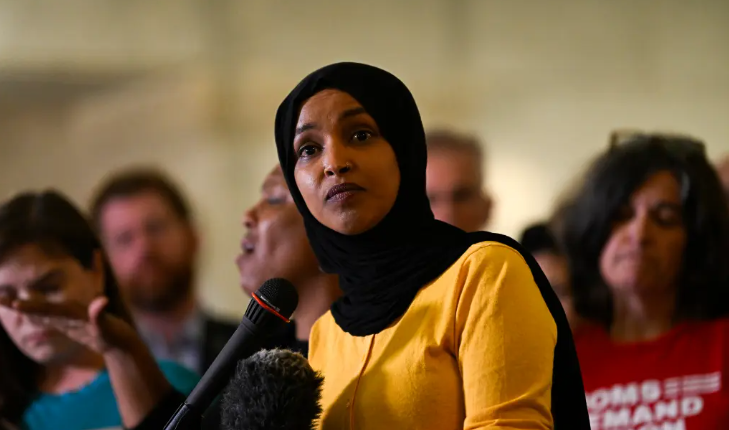
Ilhan Omar Claims She Lives Paycheck to Paycheck Despite $174K Salary as Feds Investigate $30 Million Financial Disclosure
Rep. Ilhan Omar is claiming she still lives paycheck to paycheck despite earning $174,000 annually as a member of Congress, even as federal investigators examine financial disclosures that previously suggested her household held assets valued at up to $30 million.
The Minnesota Democrat made the remarks during a Wednesday interview with MS NOW host Chris Hayes, attempting to portray herself as an ordinary working-class American while facing mounting scrutiny over her finances and immigration history.
“Working class, I guess, like paycheck to paycheck, still,” Omar said when asked about her financial situation.
The congresswoman pointed to her family responsibilities and modest vehicle as evidence that she does not enjoy the wealthy lifestyle suggested by her original financial filings.
“We’ve got four kids, and we live, I think, like a basic life. I have a Toyota Camry that’s from 2016,” she explained.
Her comments have renewed attention to the substantial discrepancies between her original congressional financial disclosure and the amended version submitted earlier this year.
The controversy began after Omar’s financial disclosure for 2024 listed assets connected to her husband, political consultant Tim Mynett, with reported values ranging from approximately $6 million to $30 million.
Two businesses accounted for the overwhelming majority of those figures.
Rose Lake Capital, a venture capital and investment firm associated with Mynett, was listed with a value between $5 million and $25 million.
A separate business, the California winery eStCru, was valued between $1 million and $5 million.
Those figures represented an extraordinary increase from earlier disclosures, which had placed the combined value of the businesses at substantially lower levels.
The apparent increase attracted attention from Republican lawmakers, including House Oversight Committee Chairman James Comer, who demanded additional information about the companies and their finances.
In February, Comer requested business records, communications and other documents from Mynett as part of a congressional inquiry into the reported valuations.
The Kentucky Republican questioned how companies that had previously reported relatively limited assets could suddenly appear to be worth tens of millions of dollars.
The committee also raised concerns about the businesses’ investors and the sources of their financing.
Omar subsequently maintained that the original figures were inaccurate.
In April, she amended her financial disclosure to report assets valued between $18,004 and $95,000, a dramatic reduction from the earlier range.
Her office attributed the discrepancy to an accounting error and insisted that the original document did not accurately represent the congresswoman’s personal wealth.
Omar has also argued that the multimillion-dollar figures reflected valuations of businesses in which her husband held ownership interests, rather than the actual value of his individual stakes.
The distinction is significant because ownership of a portion of a company does not necessarily mean an individual personally possesses assets equal to the company’s entire reported valuation.
Nevertheless, the substantial difference between the two filings has continued to generate questions about how the original figures were calculated and why the discrepancy occurred.
Earlier this month, U.S. Attorney for the District of Columbia Jeanine Pirro confirmed that federal prosecutors were examining Omar’s financial disclosures.
Pirro indicated that her office would review the facts independently of previous congressional proceedings.
The federal inquiry follows an earlier review by the Office of Congressional Conduct, which recommended dismissing misconduct allegations related to Omar’s financial filings.
Omar’s office announced in September that the congressional watchdog had voted to dismiss the allegations, describing the outcome as confirmation that she had not intentionally misrepresented her finances.
The federal investigation is separate from that congressional review and has not resulted in publicly announced criminal charges against the congresswoman.
President Trump has repeatedly questioned Omar’s reported finances and called for investigators to examine the circumstances surrounding the original disclosure.
In January, Trump publicly challenged how a member of Congress could accumulate the level of wealth suggested by the filing while earning a government salary.
The president demanded an investigation into the matter, raising questions about whether the reported increase in assets had a legitimate explanation.
Omar has denied financial wrongdoing and accused the administration of using federal investigations to target political opponents.
Her latest claims about living paycheck to paycheck come during an especially difficult period for the congresswoman, who is also facing a separate federal investigation involving her immigration history.
Earlier this month, Homeland Security Investigations agents searched Omar’s Washington, D.C., residence as part of an inquiry into records connected to her arrival in the United States and subsequent acquisition of American citizenship.
Investigators are reportedly examining whether information provided during immigration and naturalization proceedings was accurate.
One area of inquiry concerns Omar’s age when her father became a naturalized American citizen in 2000.
Federal authorities are reviewing whether discrepancies in historical immigration documents could have affected her eligibility to obtain citizenship through her father.
The investigation also reportedly involves questions about information provided by family members during the immigration process.
Omar, who arrived in the United States as a Somali refugee in 1995, has consistently denied allegations of immigration fraud.
She has characterized the investigation as politically motivated and accused President Trump’s administration of attempting to intimidate her.
No criminal charges have been announced against Omar in connection with the immigration inquiry.
During Wednesday’s interview, the congresswoman also discussed the consequences of the federal search of her Washington residence.
She said she intends to move because her home address has become publicly known and she fears for the safety of her family.
“Obviously, I can’t continue to live there,” Omar said.
She explained that the disclosure of her address, combined with threats she says she has received, has made it difficult for her children to visit safely.
The congresswoman said she no longer considers the residence suitable for her family under the circumstances.
Her comments followed a federal search that drew considerable attention because of her position as a sitting member of Congress and her longstanding political disagreements with President Trump.
Omar has been among the administration’s most outspoken opponents on immigration enforcement, foreign policy and federal spending.
The Minnesota Democrat has repeatedly criticized the president’s approach to immigration and accused federal officials of unfairly targeting immigrant communities.
Trump, meanwhile, has continued questioning Omar’s immigration history and demanding greater scrutiny of her financial affairs.
The disputes have intensified as the November 3 midterm elections approach.
Omar is seeking another term representing Minnesota’s Fifth Congressional District, which includes Minneapolis and surrounding communities.
She has represented the district since 2019 and remains one of the most prominent members of the progressive group of Democratic lawmakers known as the Squad.
Her congressional salary of $174,000 is considerably higher than the annual earnings of a typical American worker, making her description of living paycheck to paycheck a notable part of the interview.
However, income alone does not establish an individual’s available savings, household expenses or net worth.
The original $30 million figure also represented the upper end of a reported asset range, not a verified calculation of Omar’s personal fortune.
The amended disclosure, which places her reported assets below $100,000, remains central to her explanation of the controversy.
Federal prosecutors have not publicly established that Omar intentionally falsified her financial records or obtained citizenship improperly.
For now, investigators are continuing to examine the disputed disclosures and immigration documents while Omar maintains that the allegations against her are unfounded.
Her latest interview has brought the financial controversy back into the spotlight, with the congresswoman insisting she lives an ordinary working-class life despite the questions surrounding her original multimillion-dollar disclosure.
As federal investigations continue, the accuracy of those filings and the explanations provided for their dramatic revision remain central questions in the dispute.