
Mike Rogers Slams Abdul El-Sayed Over Medical Credentials During Heated Michigan Senate Debate
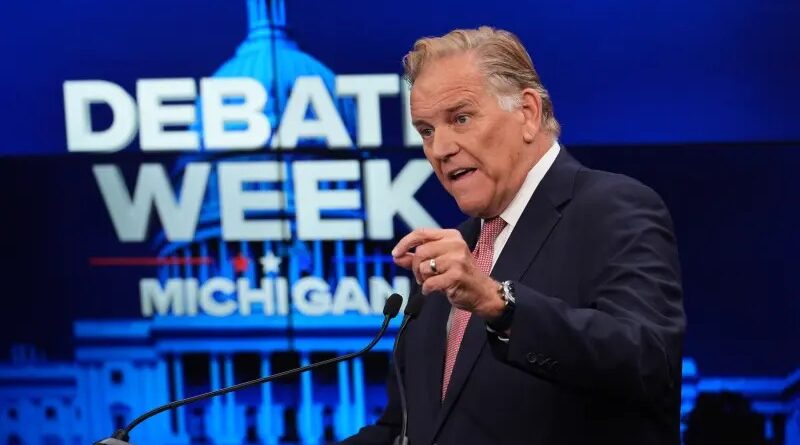
Republican Senate candidate Mike Rogers confronted Democratic opponent Abdul El-Sayed over his medical credentials during a heated Michigan debate Thursday night, accusing the progressive candidate of misleading voters by presenting himself as a practicing physician despite never obtaining a medical license.
The confrontation unfolded during the candidates’ first general election debate in Grand Rapids, where Rogers repeatedly challenged El-Sayed’s professional background. The Republican argued that his opponent has relied heavily on his medical education to promote healthcare proposals without having the qualifications necessary to independently practice medicine.
Rogers accused El-Sayed of presenting himself as something he is not, pointing out that the Democrat does not hold a license to practice medicine in Michigan or New York. He argued that El-Sayed would not legally be permitted to treat patients without the required authorization.
The Republican also described El-Sayed as a political salesman whose campaign messaging does not match his professional experience. Rogers accused his opponent of misleading voters and questioned whether they could trust his broader policy proposals.
El-Sayed defended himself by emphasizing that he earned a medical degree from Columbia University College of Physicians and Surgeons. He argued that his educational background is legitimate and that Rogers should direct any questions about his degree to the university.
The distinction between earning a medical degree and holding a medical license became central to the exchange. El-Sayed completed medical training but did not obtain a license to practice independently, instead pursuing a career in public health and epidemiology.
The Democrat previously served as executive director of the Detroit Health Department and later led Wayne County’s Department of Health, Human and Veterans Services. He also worked as a professor of epidemiology at Columbia University, where his career focused on public health rather than clinical medicine.
El-Sayed has continued describing himself as a physician in professional materials, a designation that has attracted scrutiny because Michigan law defines physicians in terms of authorization to practice medicine. However, possessing a medical degree is a separate qualification from holding an active medical license.
The dispute also extended to El-Sayed’s support for Medicare for All, a central component of his campaign platform. Rogers argued that the proposal would impose enormous costs on taxpayers and threaten the private health insurance coverage currently used by millions of Americans.
El-Sayed rejected that characterization, maintaining that his healthcare proposal would improve access to medical services and reduce financial burdens on patients. He accused Rogers of focusing on personal attacks rather than addressing healthcare affordability.
The debate became increasingly contentious as the candidates clashed over the war in Iran, President Trump’s trade policies, gasoline prices and economic conditions in Michigan. Both men repeatedly interrupted each other, prompting moderator Rick Albin to intervene.
Rogers also criticized El-Sayed’s progressive economic agenda, arguing that his proposals would increase costs for Michigan families. El-Sayed responded by accusing Rogers of changing his positions on tariffs and the Iran conflict as the November election approaches.
The Republican has recently called for an end to the war with Iran and criticized tariffs affecting trade with Canada. El-Sayed argued that those positions represented a departure from Rogers’ earlier support for policies pursued by the Trump administration.
The debate marked the first direct confrontation between the two candidates in the race to replace retiring Democratic Sen. Gary Peters. Rogers previously served in Congress and chaired the House Intelligence Committee, while El-Sayed entered the general election after narrowly defeating Rep. Haley Stevens in the Democratic primary.
Michigan’s Senate contest has attracted substantial national attention as Republicans and Democrats compete for control of the chamber. The candidates are scheduled to meet again in Detroit on October 21, giving voters another opportunity to evaluate their positions before the November 3 election.
The dispute over El-Sayed’s medical credentials remains one of the campaign’s most prominent personal controversies. Rogers maintains that his opponent’s professional descriptions are misleading, while El-Sayed insists that his medical education and public health experience qualify him to address the nation’s healthcare challenges.