
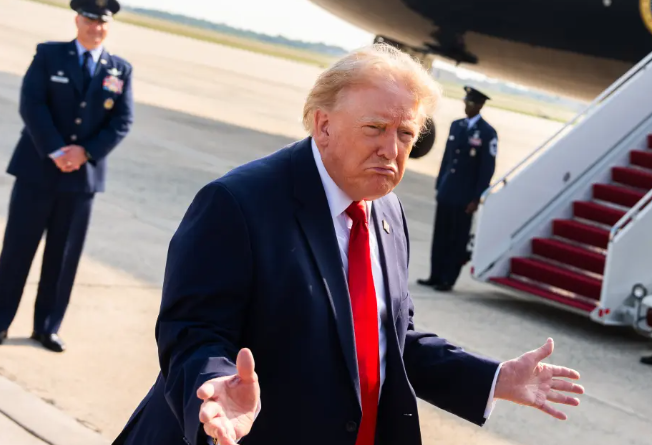
President Trump Heads to Iowa to Rally Republicans as Critical Midterm Races Tighten
President Trump is heading to Iowa on Thursday to campaign for Republican candidates as the party fights to defend key congressional seats and maintain its political influence in a state that has strongly supported him in three consecutive presidential elections.
The president is scheduled to hold a rally in Sioux City, where Republicans are working to boost voter turnout ahead of the November 3 midterm elections. The visit comes as competitive Senate, House and gubernatorial races have placed Iowa at the center of the national battle for control of Congress.
Trump carried Iowa by approximately 13 percentage points in the 2024 presidential election, continuing a string of victories that helped transform the state into a Republican stronghold. However, recent polling indicates that several statewide and congressional contests have become increasingly competitive.
The president’s appearance is intended to rally his supporters behind Republican Senate nominee Ashley Hinson, gubernatorial candidate Zach Lahn and other GOP candidates seeking office across Iowa.
Hinson, currently a member of the House of Representatives, is competing against Democratic state Rep. Josh Turek for the Senate seat being vacated by retiring Republican Sen. Joni Ernst.
The contest has attracted considerable national attention because Republicans are defending their Senate majority while Democrats attempt to gain seats in states that have generally favored the GOP in recent elections.
Hinson has emphasized her willingness to work with President Trump on policies she believes benefit Iowa, while also maintaining that she will challenge the administration when disagreements arise.
During a recent debate, Hinson said she would support the president when his decisions align with the interests of her constituents but would not hesitate to oppose policies she considers harmful.
The Republican nominee has also criticized Democratic spending proposals and argued that Iowa needs representation focused on fiscal responsibility, economic development and protecting agricultural communities.
Turek, meanwhile, has concentrated much of his campaign on rising household expenses, the administration’s trade policies and the economic consequences of the ongoing conflict involving Iran.
The war has become a significant issue in Iowa, particularly because of its effects on fuel prices and agricultural operating costs.
Hinson has publicly called for a swift conclusion to the conflict, expressing concern that farmers and working families are facing additional financial burdens from rising energy prices.
She has also opposed a recent agreement involving Russian diesel imports, joining other Iowa Republicans who have questioned whether the administration should pursue energy arrangements with Moscow while Russia continues its war against Ukraine.
The disagreement illustrates the challenges facing Republican candidates attempting to balance their support for Trump’s broader agenda with concerns raised by voters in their districts.
Republican Reps. Zach Nunn and Mariannette Miller-Meeks have also taken positions that differ from the White House on certain foreign policy matters.
Both lawmakers joined Democrats last month in supporting legislation intended to restrict the president’s authority to conduct military operations involving Iran without additional congressional authorization.
Nunn and Miller-Meeks are defending their House seats in competitive districts, while Democrats are also targeting an open seat in Iowa’s Second Congressional District.
The outcome of these races will contribute to determining which party controls the House of Representatives when the new Congress convenes in January.
Republicans currently hold narrow majorities in Congress, making individual races important to the party’s ability to advance the administration’s legislative priorities.
Trump has repeatedly emphasized that the party holding the White House traditionally faces difficulties during midterm elections. His campaign schedule reflects an effort to encourage participation among voters who supported him in presidential contests but may not consistently vote in congressional elections.
The president has urged his supporters to approach the November election with the same urgency they demonstrated when he was personally on the ballot.
Iowa’s gubernatorial contest has also become increasingly competitive.
Republican Zach Lahn is running against Democratic State Auditor Rob Sand in the race to succeed outgoing Gov. Kim Reynolds.
Recent surveys have shown Sand ahead of Lahn, although the election remains undecided and both campaigns are continuing their efforts to reach voters.
Sand has focused on government accountability and economic concerns, while Lahn has emphasized conservative policies and his support for the state’s Republican leadership.
Trump’s visit provides Lahn with an opportunity to appear alongside the president in a region of Iowa where Republican candidates have traditionally performed well.
Sioux City is located in the state’s heavily Republican northwest, an area that has provided substantial support for Trump during his previous presidential campaigns.
The location also gives the president an opportunity to address rural voters, including farmers who have expressed concern about rising operating expenses and uncertainty involving international trade.
Agriculture remains a major component of Iowa’s economy, making fuel prices, export markets and federal farm policy particularly important to the state’s political debate.
Farmers have faced pressure from higher production costs and uncertainty surrounding international markets, issues that have become prominent in the final weeks of the campaign.
A Marist survey conducted in October found that 42% of likely Iowa voters believed their financial situation had worsened over the previous year.
The findings included substantial dissatisfaction among independent voters, a group both parties are attempting to reach before Election Day.
The same survey found that 35% of likely voters viewed their midterm vote as an expression of opposition to President Trump, while 21% described it as a vote in support of him.
Those results underscore the degree to which the president remains a central figure in congressional campaigns, even when his name does not appear on the ballot.
National polling has also reflected challenges for the administration.
A Reuters/Ipsos survey released Monday placed Trump’s approval rating at 31%, while 68% of respondents disapproved of his handling of the economy.
The president has continued to defend his economic agenda, arguing that his administration’s policies will strengthen domestic manufacturing, protect American workers and improve the country’s long-term financial position.
He has also maintained that energy prices will decline as the conflict involving Iran moves toward a resolution.
Trump’s Iowa visit is part of an extensive campaign tour that has taken him to several Republican-leaning states where congressional races have drawn national attention.
Earlier this week, the president traveled to Kansas to campaign for Republican Sen. Roger Marshall, whose reelection contest has become more competitive than initially anticipated.
On Tuesday, Trump delivered a nearly two-hour speech in North Carolina, where he campaigned for Republican Senate nominee Michael Whatley.
He then traveled to South Carolina on Wednesday to support the Republican Senate campaign there before preparing for Thursday’s appearance in Sioux City.
The president has made clear that he intends to maintain an active campaign schedule through the final days before the election.
Trump is also expected to return to Iowa on November 1, just two days before voters head to the polls.
The second visit reflects the importance his campaign places on turnout in a state where Republicans have built substantial political advantages over the past decade.
Iowa Republican Party Chairman Jeff Kaufmann has welcomed the president’s involvement, saying Trump wants voters to hear directly from him before making their decisions.
Democratic candidates have also used the president’s appearances to highlight their disagreements with his administration’s policies, particularly on economic issues and the Iran conflict.
With early voting already underway in Iowa, both parties are concentrating on mobilizing their existing supporters while competing for undecided voters.
For Republicans, the immediate objective is to defend their Senate seat, protect vulnerable House incumbents and retain control of the governor’s office.
For President Trump, the Iowa campaign stop represents another opportunity to connect his national policy agenda with the candidates seeking to represent the state in Washington and Des Moines.
The November 3 election will determine whether Republicans maintain their current congressional majorities and whether Iowa continues its recent pattern of Republican leadership in statewide offices.