
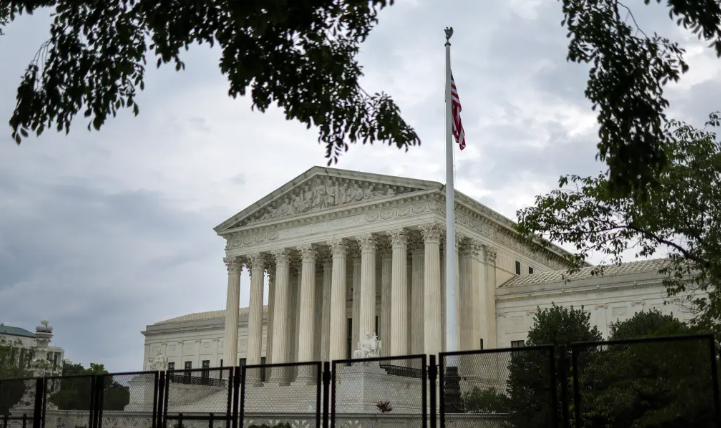
Supreme Court Rejects Trump Administration’s Emergency Bid to Set Aside 20,000 California Mail-In Ballots
President Trump’s administration took its battle over election integrity to the United States Supreme Court on Monday, seeking an emergency order requiring California to separate mail-in ballots associated with more than 20,000 registered voters suspected of being noncitizens. The nation’s highest court rejected the request just hours later, leaving the disputed ballots subject to California’s existing election procedures.
The legal confrontation unfolded one day before the November 3 midterm elections, with Republicans fighting to maintain control of Congress and the administration demanding additional scrutiny of voter eligibility in the nation’s most populous state.
Federal officials argued that California was refusing to cooperate with efforts to identify individuals who may be unlawfully registered to vote. State officials disputed the reliability of the government’s findings and warned that the proposed restrictions could prevent eligible American citizens from having their votes counted.
The Justice Department’s emergency application asked the Supreme Court to require California election officials to segregate ballots connected to approximately 20,000 individuals identified by federal authorities as likely noncitizens.
Under the proposal, the ballots would be held separately until officials could verify the voters’ citizenship status. The administration maintained that the measure would preserve potentially unlawful ballots for further review without permanently excluding votes cast by eligible citizens.
Solicitor General D. John Sauer argued that once disputed ballots were mixed with legitimate ballots, officials would lose the ability to identify and remove individual votes if subsequent investigations established that they were cast illegally.
The administration’s position centered on the difficulty of separating ballots after they have been processed and removed from their identifying envelopes. Federal attorneys warned that delaying action could make any eventual court ruling ineffective.
The Supreme Court nevertheless denied the emergency application in a brief, unsigned order. The justices provided no explanation for their decision, and no member of the court publicly dissented.
The ruling did not determine whether every voter identified by the federal government was eligible. Instead, it rejected the administration’s request for immediate judicial intervention in California’s ongoing election.
The dispute began in October after the Department of Homeland Security compiled information identifying thousands of individuals whose citizenship status federal officials believed warranted additional examination.
The Justice Department subsequently provided California election authorities with a list containing more than 20,000 names and requested that ballots associated with those individuals be separated from other votes.
California officials refused, maintaining that the federal government’s information contained significant inaccuracies and did not establish that the individuals were unlawfully registered.
The disagreement escalated on October 15 when the Justice Department filed a lawsuit against California election officials, arguing that the state’s refusal to cooperate interfered with the enforcement of federal laws prohibiting noncitizen voting.
Federal law prohibits noncitizens from voting in federal elections, although verified cases of unlawful noncitizen voting are uncommon.
The administration argued that its request was a limited precaution designed to protect the integrity of the election while officials determined whether the flagged registrations were valid.
California Attorney General Rob Bonta opposed the lawsuit, contending that the government’s evidence was insufficient and that complying with the request could interfere with the voting rights of legitimate citizens.
State officials also warned that implementing the proposed restrictions shortly before Election Day would create major administrative problems.
California automatically mails ballots to registered voters, and millions of residents had already returned their ballots before the federal government sought emergency relief.
Election officials explained that ballots are processed throughout the voting period, making it difficult to isolate particular votes after they have entered the tabulation system.
The administration’s legal challenge initially reached U.S. District Judge David O. Carter in Los Angeles.
Carter denied the Justice Department’s request for a temporary restraining order on October 28, finding that the government had not demonstrated sufficient grounds for the extraordinary intervention it sought.
The judge expressed concerns about the reliability of the federal voter list and the possibility that eligible citizens could be affected by the proposed restrictions.
Federal prosecutors appealed the ruling to the Ninth Circuit Court of Appeals, where a divided three-judge panel considered the administration’s request.
On October 30, the appeals court declined to order California to separate the disputed ballots.
Judges Mark Bennett, appointed by President Trump, and Gabriel Sanchez, appointed by President Joe Biden, formed the majority against granting emergency relief.
Judge Patrick Bumatay, another Trump appointee, dissented, arguing that the administration’s concerns about potential violations of federal election law justified intervention.
The divided ruling prompted the Justice Department to seek assistance from the Supreme Court.
Federal attorneys maintained that immediate action was necessary because the election was already underway and disputed ballots could become impossible to identify after processing.
California officials continued arguing that the administration’s voter list was unreliable.
A review by Los Angeles County officials of a sample of 200 registrations reportedly found that nearly 40% of the individuals appeared to have been born in the United States.
The same review found that more than 70% had no recorded voting history, raising additional questions about whether the government’s list accurately identified individuals who had cast or would cast ballots.
A separate analysis by the UCLA Voting Rights Project found that more than four in ten names on the federal list were not present on California’s current voter rolls.
Those findings became central to the state’s argument that the proposed restrictions could affect eligible voters without sufficient evidence of unlawful activity.
Justice Department officials acknowledged that the data could contain errors but maintained that cooperation from state election administrators was necessary to verify the information.
Federal prosecutors emphasized that they were not asking the courts to permanently invalidate every disputed ballot. Instead, they wanted the ballots preserved separately until citizenship verification could be completed.
The administration also argued that California’s refusal to assist federal authorities frustrated enforcement of laws intended to prevent unlawful participation in federal elections.
Bonta and Gov. Gavin Newsom rejected that position, accusing the administration of attempting to disrupt voting shortly before a consequential national election.
Following the Supreme Court’s decision, Bonta celebrated the ruling as another victory for California after the administration’s repeated defeats in lower courts.
Newsom likewise praised the outcome, maintaining that the state’s existing election procedures should remain in place.
The confrontation unfolded against the backdrop of President Trump’s broader efforts to strengthen voter eligibility requirements and prevent noncitizens from participating in federal elections.
The administration has pursued voter registration information from multiple states and advocated additional citizenship verification measures.
California’s lawsuit raised questions about the limits of federal executive authority over state election administration, particularly when federal officials seek changes after voting has begun.
The Constitution assigns states primary responsibility for administering federal elections, subject to rules established by Congress. That division of authority has been central to the legal arguments surrounding the administration’s demands.
The Supreme Court’s refusal to grant emergency relief leaves the lower court decisions in place as Californians prepare to finish voting.
The ruling does not prevent federal authorities from investigating credible allegations of unlawful voting or pursuing prosecutions when evidence establishes violations of federal law.
It does, however, prevent the administration from immediately requiring California to segregate the approximately 20,000 disputed ballots under the emergency order it requested.
With Election Day approaching, the decision marks a significant legal setback for the Justice Department’s effort to impose additional ballot verification procedures in California.
The underlying dispute over voter eligibility and the federal government’s authority to demand election records may continue through further litigation.
For now, California election officials will proceed under the state’s existing voting procedures, while the Trump administration’s broader efforts to strengthen citizenship verification remain the subject of ongoing legal and political debate.