
Trump Launches ‘Operation Economic Outcast’ Against Iran as Bessent Vows to ‘Tighten the Noose’
President Donald J. Trump’s administration launched a sweeping new economic offensive against Iran Monday, unveiling “Operation Economic Outcast” as Treasury Secretary Scott Bessent warned countries around the world to stop doing business with Tehran or risk being hit with powerful American sanctions.
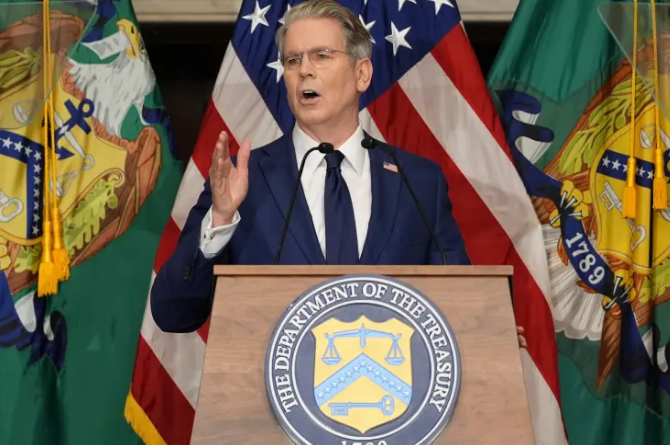
Bessent announced the campaign from Treasury Department headquarters in Washington, describing it as the administration’s long-promised “Economic D-Day.” The strategy is designed to systematically eliminate the financial networks, trade relationships and revenue streams Iran continues using to sustain its government and military operations.
“Our objective is to sever every economic lifeline that sustains this tyrannical regime until Tehran stands alone,” Bessent said. He warned that the administration intends to pursue a “zero leakage approach,” leaving Iran with virtually no economic breathing room to rebuild its finances or circumvent American restrictions.
The new sanctions authorities target five major areas Iran has allegedly used to evade previous restrictions: digital assets, technology, gold, commercial aviation and shipping. Treasury officials say Tehran has increasingly relied on cryptocurrency, gold transactions, aircraft and shipping networks to move money, weapons and other valuable resources around the world.
As the operation began, the Treasury Department sanctioned more than 60 individuals, companies and vessels accused of helping Iran generate oil revenue, acquire nuclear and ballistic-missile technology or conduct cyber operations. Some of the targeted networks are located in China, the United Arab Emirates, Hong Kong, Singapore, Switzerland and other countries.
Bessent made clear that foreign governments and companies are also in Washington’s sights. Countries are being privately told what economic relationships with Iran they must terminate, although the administration has not publicly disclosed specific deadlines. “The clock just started ticking,” Bessent warned, adding that the United States does not have “infinite patience.”
China could become the biggest test of Trump’s strategy because Beijing purchases roughly 90% of Iran’s exported oil. Asked whether Chinese companies and financial institutions could face punishment, Bessent responded that “no one is above the reach of US sanctions.” Trump is scheduled to meet Chinese President Xi Jinping next month, potentially putting Iran near the center of those discussions.
The United Arab Emirates has already halted trade and financial transactions with Iran, a move Bessent praised while predicting additional countries would follow. Trump spoke with UAE President Sheikh Mohammed bin Zayed shortly before Monday’s announcement, while Bessent suggested another major financial institution could be sanctioned before the end of the week.
Washington is also pressuring countries to close overseas branches of Bank Melli, Iran’s largest government-owned commercial bank. Branches remain in several countries, including Britain, France, Germany and Russia, making the banking network another potential target as Washington attempts to cut Tehran off from the international financial system.
The administration’s ultimate leverage is access to the enormous American economy and the U.S. dollar. Foreign businesses and financial institutions that continue facilitating Iranian transactions could face secondary sanctions that severely restrict their ability to participate in the American financial system.
Bessent presented Tehran with two possible futures: continued resistance resulting in “complete global isolation and a subsistence economy,” or an agreement with Washington that could eventually allow Iran to rejoin the global economy. The administration believes increasingly severe economic pressure can force Iranian leaders to reconsider their refusal to accept American demands.
Operation Economic Outcast therefore represents a major shift into the financial phase of Trump’s confrontation with Tehran. Rather than relying exclusively on military pressure, Washington is attempting to make Iran economically radioactive to the rest of the world — forcing governments and companies to decide whether maintaining ties with Tehran is worth risking their own access to the American economy.