
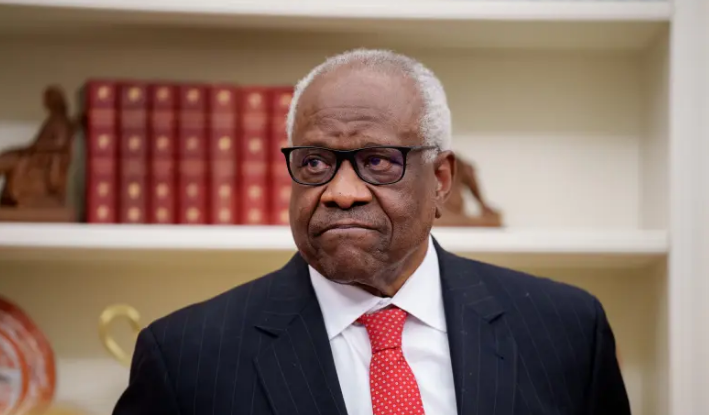
Clarence Thomas Rejects Idea Black Americans Must Be Liberal: ‘Indentured Servitude’
Supreme Court Justice Clarence Thomas is pushing back forcefully against the idea that Black Americans are expected to hold a particular set of political beliefs, arguing that judging someone’s views according to skin color amounts to a form of ideological control.
Thomas, 78, discussed his experiences as one of America’s most prominent Black conservatives during an appearance on Sen. Ted Cruz’s “Verdict” podcast. The conversation accompanied the release of Cruz’s book about Thomas and his life on the Supreme Court.
Thomas recalled arriving in Washington and encountering people who assumed his race should determine his politics. He said critics sometimes treated his conservative beliefs as evidence that he was somehow confused about his own interests.
“I’m not confused. You’re confused,” Thomas said, before comparing the expectation that he conform politically to “indentured servitude.” He argued that people should not be told how they are supposed to think simply because of their skin color.
Thomas described that attitude as a “deterministic view” of race, saying individuals should be free to develop their political and philosophical beliefs independently. His own political evolution, he explained, was heavily influenced by his family, religion and personal experiences.
The justice credited his grandfather with shaping much of his worldview. Thomas recalled challenging his grandfather about America’s problems, only to be asked what country was better despite those shortcomings. Thomas said he could not provide an answer.
His grandfather’s life also left a lasting impression on him. Thomas has previously explained that his grandfather had little formal education and was raised by a formerly enslaved person, yet maintained a strong work ethic and refused to spend his life complaining about his circumstances.
Thomas was not always politically conservative. During his younger years, he embraced left-wing activism and participated in an anti-war demonstration around Harvard Square in 1970 that eventually descended into violence. He described the experience as a major turning point in his life.
After the riot, Thomas said he found himself exhausted and disturbed by what had happened. He went to a chapel and prayed for God to remove hatred from his heart, describing the experience as his “Road to Damascus moment” and the beginning of a move toward a different outlook.
Thomas also discussed conservative economist Thomas Sowell, whose writings eventually influenced his thinking. Although Thomas initially reacted negatively when someone gave him Sowell’s “Black Education: Myths and Tragedies” while he was in law school, he later returned to the book and became more receptive to its arguments.
The justice also thanked Cruz and Sen. Mike Lee for publicly defending him and his wife, Ginni Thomas, during controversies involving her conservative political activities and scrutiny over gifts Thomas received from wealthy friends.
Thomas has now served on the Supreme Court for nearly 35 years, making him the longest-serving current justice and the second Black justice in American history. Throughout that career, his conservative judicial philosophy has frequently placed him at the center of political controversy.
But Thomas suggested that criticism has only strengthened his determination to reject expectations based on race. His message was that Black Americans, like everyone else, should be treated as individuals capable of reaching their own conclusions rather than being expected to conform to a predetermined political ideology.