
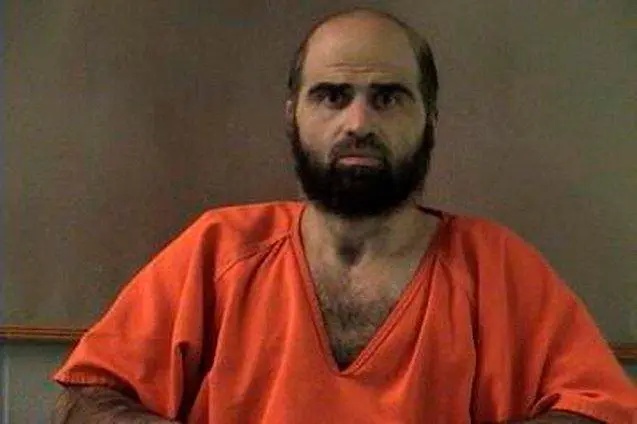
Trump Says He Was Not Involved in Plan to Livestream Fort Hood Killer’s Execution, Will Make Final Decision
President Trump said he was not involved in the military’s decision to livestream the execution of convicted Fort Hood mass murderer Nidal Hasan, while making clear that he supports carrying out the death sentence against the former Army psychiatrist responsible for killing 13 people in 2009.
The president addressed the controversy after Defense Secretary Pete Hegseth announced plans to publicly broadcast Hasan’s execution by firing squad on December 3. The proposal has generated considerable attention because the United States has never livestreamed a military execution for the general public.
During an interview Friday in Syracuse, New York, Trump explained that he had not participated in the decision to broadcast the execution. However, he acknowledged the military’s reasoning for considering the unusual measure, which officials believe could serve as a deterrent against future attacks.
The president later clarified Saturday that he would ultimately decide whether the livestream moves forward. He said there were competing arguments about broadcasting the execution, including whether showing the consequences of Hasan’s actions might discourage others from committing similar crimes.
Trump emphasized that his support for Hasan’s execution should not be confused with a final decision about making the proceedings available to the public. The president has approved the military’s plan to carry out the death sentence by firing squad, but the broadcast remains under consideration.
Hasan, a former Army major and psychiatrist, was convicted of murdering 13 people and wounding 32 others during a shooting rampage at Fort Hood, Texas, on November 5, 2009. The attack occurred at a military processing center where soldiers were preparing for deployment.
The victims included 12 military personnel and one civilian employee. The shooting became one of the deadliest attacks at an American military installation and prompted extensive investigations into military security procedures and the warning signs preceding the massacre.
During his 2013 court-martial, Hasan acknowledged responsibility for the killings. He claimed that his actions were intended to protect Taliban fighters from American military operations overseas.
A military jury convicted Hasan of 13 counts of premeditated murder and 32 counts of attempted premeditated murder. He was subsequently sentenced to death and has remained in military custody while his case proceeded through the appeals process.
Earlier this week, the Army announced that Hasan’s execution had been scheduled for December 3 at Fort Hood, the same installation where the murders occurred. If carried out, it would mark the first execution conducted by the United States military since 1961.
The use of a firing squad would also represent a rare event in modern American military history. The military has not executed a prisoner using that method since 1945, shortly after the end of World War II.
Hegseth has strongly supported the decision to make the execution public. During an interview with conservative commentator Jack Posobiec, the defense secretary argued that Americans should understand the serious consequences associated with committing acts of mass murder.
Pentagon officials subsequently confirmed that the military intended to livestream the proceedings, although they did not immediately provide details about how the broadcast would operate or whether restrictions would be imposed on viewers.
The announcement prompted objections from several Republican lawmakers, including North Carolina Sen. Thom Tillis, who argued that executions should not become public spectacles. Tillis supported holding Hasan accountable but questioned whether broadcasting his death would serve an appropriate purpose.
Alaska Sen. Lisa Murkowski also criticized the proposal, warning that a public execution could provide Hasan with additional notoriety. Other lawmakers expressed concern that extremist organizations might exploit the footage for propaganda purposes.
Vice President JD Vance expressed reservations about the proposed livestream and said he would not watch the broadcast if it proceeded. Vance also suggested that the administration had not reached a final decision about whether the public would be permitted to view the execution.
Religious leaders and international human rights organizations have raised additional objections. Pope Leo XIV reiterated the Catholic Church’s opposition to capital punishment, while United Nations officials criticized the idea of broadcasting an execution.
The controversy has also prompted discussion among military legal experts about the procedures required to carry out a death sentence. Questions remain about the execution method, the availability of additional legal challenges and the rules governing public access to military executions.
Despite the dispute over the livestream, Trump has remained firm in his support for Hasan receiving the death penalty. The president described the former Army officer as a vicious killer and argued that the severity of his crimes warranted the punishment imposed by the military court.
The president’s comments indicate that the administration is distinguishing between the execution itself and the decision to broadcast it. While the death sentence has received presidential approval, the question of public access has not been conclusively resolved.
For the families of the 13 victims and the survivors who were wounded, the scheduled execution represents another major development in a case that has continued for nearly 17 years. The military is preparing to carry out the sentence as the White House considers whether the proceedings should remain private or be broadcast to the public.
Trump has indicated that he will weigh the arguments before making his final decision. Until then, the December 3 execution remains scheduled, while the Pentagon’s proposal to livestream it continues to face scrutiny from lawmakers, religious leaders and military legal authorities.