
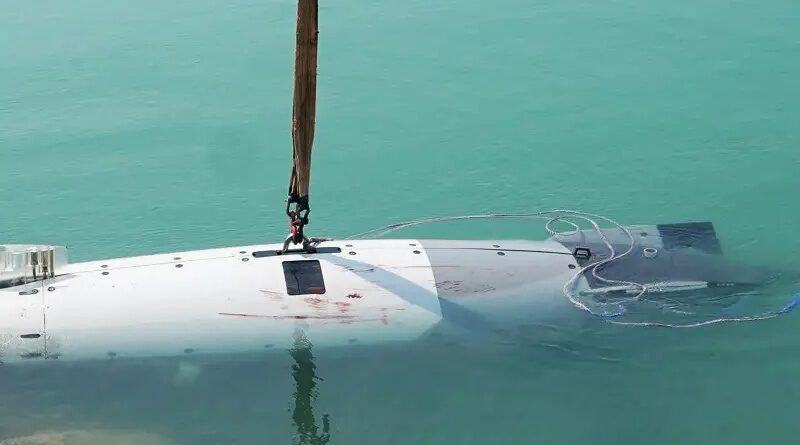
Iran Could Use Captured US Navy Drone Sub to Advance Its Own Underwater Weapons
Iran could attempt to reverse-engineer a captured U.S. Navy underwater drone to improve its own military technology, raising concerns that Tehran could learn from the American system even though U.S. officials say it contained no classified equipment.
Iran’s Islamic Revolutionary Guard Corps recently recovered an Anduril Dive-LD autonomous underwater vehicle near the entrance to the Strait of Hormuz. Iranian officials portrayed the recovery as a sophisticated military operation, while U.S. Central Command said the drone had malfunctioned and had been disabled in the water for more than a day before Iran obtained it.
The Dive-LD is approximately 19 feet long and weighs about three tons. Designed for long-duration autonomous missions, it can descend nearly 20,000 feet and remain operational for up to 10 days. Its potential missions include reconnaissance, mine detection, seabed mapping and inspection of underwater infrastructure.
U.S. officials have sought to minimize the intelligence value of the captured vehicle. Central Command said the lost drone was an older model that did not collect sensitive information and was not carrying classified sonar or radar equipment when it malfunctioned.
Defense experts nevertheless say Iran could gain useful information by examining the vehicle’s physical construction and electronic components. Areas of interest could include its power system, navigation equipment, communications technology and sensors, potentially helping Iran improve its own underwater drones or develop methods for detecting and disrupting American systems.
Iran may face greater difficulty accessing encrypted software and other protected elements of the vehicle. Even without reproducing the entire system, however, specialists say Tehran could study individual components or potentially share information obtained from the drone with military partners such as Russia.
The incident is not the first time advanced American unmanned technology has fallen into Iranian hands. Iran recovered a U.S. RQ-170 Sentinel surveillance drone in 2011 and subsequently displayed aircraft that it said were developed using technology learned from the captured American system.
The latest capture comes as autonomous vehicles play an increasingly important role in naval operations. The U.S. military has expanded its use of unmanned systems for missions that would otherwise expose sailors, ships and submarines to greater danger in contested areas.
The loss also highlights the risks associated with deploying unmanned technology near hostile forces. Systems such as the Dive-LD are intended to operate in dangerous environments where losing an individual vehicle is considered a possibility, but any relatively intact platform recovered by an adversary can still provide an opportunity to study American engineering and develop potential countermeasures.